Core Strength After 40: More Than Just Abs
When most people hear "core training," they picture crunches, sit-ups, and the endless pursuit of a flat stomach. And honestly? That outdated thinking has done women over 40 a massive disservice. Because your core is not about how your midsection looks — it is about how your entire body functions.
Your core is the foundation of every movement you make. Getting out of bed, carrying groceries, picking up grandchildren, maintaining balance on uneven ground — it all starts with your core. And after 40, when hormonal changes, reduced muscle mass, and years of sitting begin to take their toll, training your core properly is not optional. It is essential.
Free 7-Day Beginner Strength Plan
Three simple full-body dumbbell workouts with form cues, warm-ups and rest days built in — designed for women over 40.
🔒 No spam, ever. Unsubscribe anytime.
What Your Core Actually Is
Here is the part most fitness content gets wrong: your core is not just your "abs." It is a complex system of muscles that wraps around your entire torso like a corset, providing stability, support, and power transfer. It includes:
- Rectus abdominis — the "six-pack" muscles (the ones everyone obsesses over)
- Transverse abdominis — the deepest layer, acting like a natural weight belt
- Internal and external obliques — the muscles along your sides that help you twist and bend
- Erector spinae — the muscles running along your spine that keep you upright
- Pelvic floor — the hammock of muscles at the base of your pelvis (hugely important for women)
- Diaphragm — your primary breathing muscle, which works in concert with the rest of your core
- Multifidus — small, deep muscles that stabilise individual vertebrae
When all of these muscles work together, you have a stable, powerful centre that protects your spine, supports your organs, and allows you to move with confidence. When they do not? That is when back pain, poor posture, incontinence, and falls become a problem.
Why Core Strength Matters More After 40
Several things change in midlife that make core training increasingly important:
Hormonal Shifts and Muscle Loss
Declining oestrogen accelerates sarcopenia — the natural loss of muscle mass that begins around 30 and speeds up significantly after 40. Your core muscles are not immune. Without targeted training, they weaken alongside everything else, leaving your spine less supported and your balance compromised.
Pelvic Floor Changes
Pregnancy, childbirth, hormonal changes, and ageing all affect pelvic floor strength. A weak pelvic floor contributes to stress incontinence (leaking when you cough, sneeze, or jump), pelvic organ prolapse, and reduced sexual function. Your pelvic floor is part of your core — training one without the other is like building a house without a foundation.
Spinal Health and Posture
Years of sitting, driving, and hunching over screens take a cumulative toll on your spine. A strong core supports proper spinal alignment, reduces the load on your discs and joints, and can significantly reduce or prevent lower back pain — the number one musculoskeletal complaint in women over 40.
Balance and Fall Prevention
Your core is your body's stabilisation centre. Every time you trip, stumble, or navigate uneven ground, it is your core muscles that fire first to keep you upright. As we age, balance naturally declines — but a strong core dramatically reduces fall risk. This is not a vanity issue. It is a safety issue.
The Core Exercises That Actually Matter
Forget hundreds of crunches. The most effective core exercises for women over 40 focus on stability, anti-movement, and functional integration. Here are the categories that deliver real results:
Anti-Extension (Resisting Arching)
These exercises train your core to prevent your lower back from over-arching — critical for spinal protection.
- Dead bugs: Lie on your back, press your lower back into the floor, and slowly extend opposite arm and leg while maintaining that back position. Start with 3 sets of 8 per side.
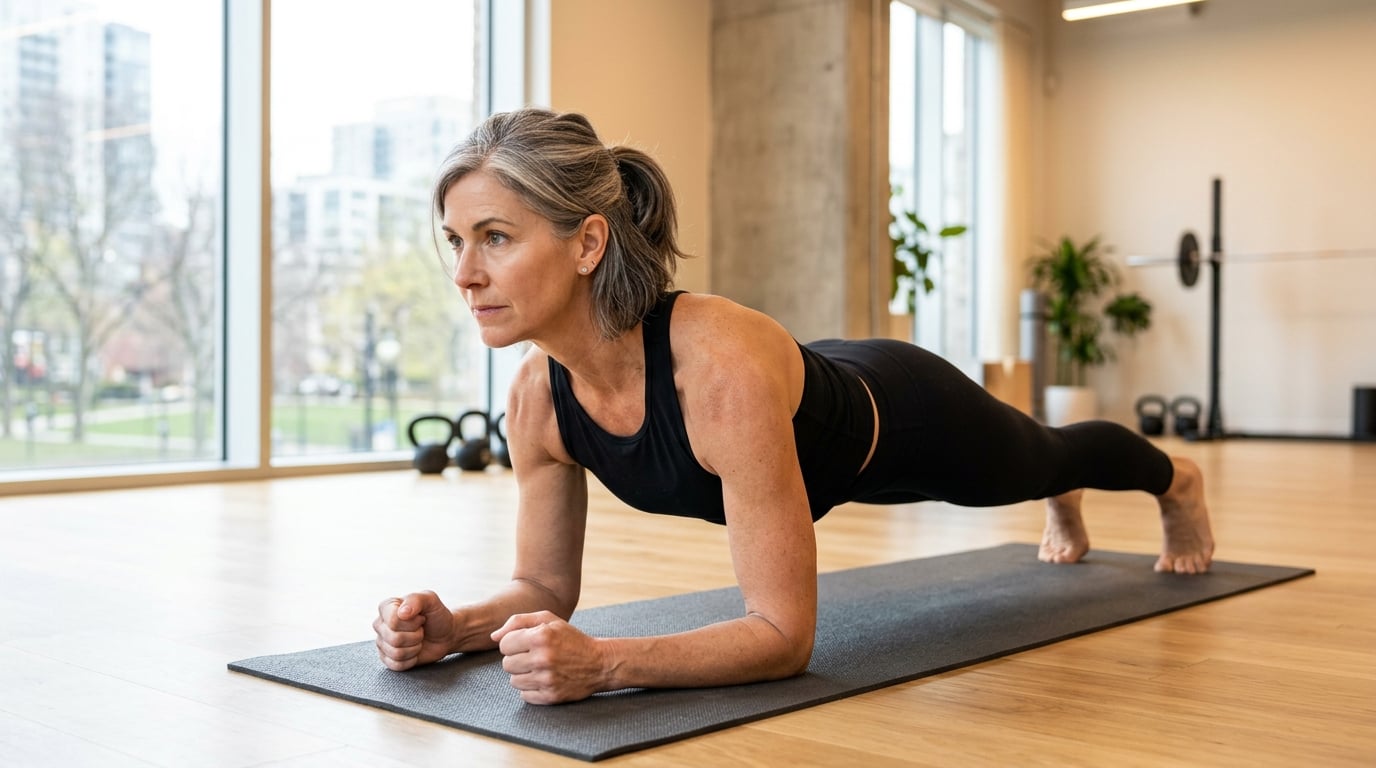
- Plank variations: A proper plank is an anti-extension exercise. Focus on squeezing your glutes and bracing your core, not just surviving for time. 3 sets of 20–30 seconds with perfect form beats 2 minutes of sagging.
Anti-Rotation (Resisting Twisting)
Your core's ability to resist unwanted rotation protects your spine during everyday movements — carrying a bag on one shoulder, pushing a door open, catching yourself from a stumble.
- Pallof press: Using a resistance band anchored at chest height, press the band straight out from your chest and hold. Your core works to resist the band pulling you sideways. 3 sets of 10 per side.
- Single-arm farmer's carry: Carry a heavy weight in one hand and walk for 20–30 metres. Your core fires on the opposite side to keep you upright. Simple, effective, functional.
Anti-Lateral Flexion (Resisting Side Bending)
These strengthen your obliques and the muscles along your spine in a way that translates directly to real life.
- Side plank: Modified on your knees if needed. Hold for 15–20 seconds per side, 3 sets. Quality over duration.
- Suitcase carry: Similar to the farmer's carry but with focus on one side at a time. Walk tall, do not lean.
Pelvic Floor Integration
Train your pelvic floor as part of your core, not in isolation.
- Diaphragmatic breathing with pelvic floor engagement: Inhale deeply, letting your belly expand. As you exhale, gently lift your pelvic floor (imagine stopping the flow of urine) while drawing your lower belly in. 3 sets of 10 breaths.
- Glute bridges with core brace: Before you lift your hips, exhale, engage your pelvic floor, and brace your core. This teaches all the muscles to work as a unit. 3 sets of 12.
A Simple Weekly Core Plan
You do not need a separate "core day." Integrate these exercises into your existing routine or do them as a standalone 10–15 minute session two to three times per week.
- Dead bugs: 3 × 8 per side
- Pallof press: 3 × 10 per side
- Side plank: 3 × 15–20 seconds per side
- Glute bridge with core brace: 3 × 12
- Diaphragmatic breathing: 3 × 10 breaths (great cool-down)
This takes about 12 minutes and covers every function of your core. No crunches required.
Common Core Training Mistakes to Avoid
- Doing hundreds of crunches: Crunches primarily target the rectus abdominis while ignoring the deeper stabilising muscles. They also repeatedly flex your spine, which can aggravate disc issues. Skip them.
- Holding your breath: Breathing is part of core function. If you are holding your breath during exercises, you are bypassing your diaphragm and pelvic floor — two critical core components.
- Chasing the burn: Core training should feel like controlled effort, not burning agony. If your lower back is aching or your neck is straining, your form needs adjusting, not your effort.
- Ignoring your pelvic floor: Especially after pregnancy or during perimenopause. If you experience leaking during exercise, see a pelvic health physiotherapist. It is common, but it is not something you should just "accept."
- Only training in one plane: Life happens in all directions. Your core training should include anti-extension, anti-rotation, and anti-lateral flexion — not just forward-facing movements.
Core Strength Is Functional Freedom
A strong core will not necessarily give you a six-pack — and honestly, that was never the point. What it will give you is the ability to move through life with confidence, stability, and zero fear. It means bending down without wincing. Lifting heavy bags without worrying about your back. Playing on the floor with grandchildren and getting back up with ease.
That is what core strength really is. Not a look. A capability. And it is yours to build — starting exactly where you are today.
Free 7-Day Beginner Strength Plan
Three simple full-body dumbbell workouts with form cues, warm-ups and rest days built in — designed for women over 40.
🔒 No spam, ever. Unsubscribe anytime.
Want personalised help with this?
My 1:1 online coaching gives you a fully custom training and nutrition plan built around your goals, your body, and your life. 12 weeks, $69/week, with me in your corner the whole way.
Learn About CoachingFree 7-Day Fat Loss Meal Plan
A printable week of protein-forward meals, shopping list, meal prep guide and tracker — designed for women over 40.