Getting Started After 40: A Beginner's Guide to Beating Gym Intimidation
Let me talk to the woman who has been meaning to start for months — maybe years. You know you should be exercising. You've read the articles, you've had the conversations with yourself, you've maybe even bought the workout gear that's still sitting in a drawer with the tags on. But every time you think about actually walking into a gym or starting a programme, something stops you. Fear. Overwhelm. The feeling that everyone else already knows what they're doing and you'll look foolish.
I want you to know something: that feeling is completely normal, incredibly common, and absolutely not a reason to keep waiting. I've helped hundreds of women over 40 take their very first steps into strength and fitness, and almost every single one of them felt exactly the way you do right now. The difference between the women who transform their lives and the women who stay stuck isn't confidence — it's that the first group started anyway, scared and all.
Free Protein Cheat Sheet
Your daily protein target, the protein in 40+ everyday foods, and 25 easy high-protein snacks — all on one printable page.
🔒 No spam, ever. Unsubscribe anytime.
Why Starting After 40 Feels So Hard
There's a unique kind of intimidation that comes with starting later in life. You're not 20 anymore, bouncing into a gym without a second thought. You might feel self-conscious about your fitness level, your body, or simply being surrounded by people who seem to know what they're doing. You might worry you've left it too late. You might have tried before and it didn't stick, and starting again feels like admitting a past failure.
Here's the truth that changes everything: nobody is watching you the way you think they are. The people at the gym are focused on their own workouts, their own insecurities, their own goals. And the ones who do notice a woman over 40 showing up for herself? They respect it. Deeply.
The Mindset Shift That Makes It Possible
Before we talk about what to do, we need to talk about how to think. Because the biggest barrier is never physical — it's mental. Stop thinking of exercise as something you have to be good at, and start thinking of it as something you're simply learning. You wouldn't expect to be fluent the first time you tried a new language. Fitness is exactly the same. Every strong, capable woman you admire was once a complete beginner who felt awkward and unsure.
Give yourself permission to be a beginner. It's not a weakness — it's the brave, necessary starting point of every single success story.
Your First Steps: A Simple Starting Plan
1. Start smaller than you think you need to
The most common mistake beginners make is going too hard, too fast — then burning out or getting injured within two weeks. I'd rather you did two short sessions a week that you actually enjoy and repeat, than five brutal sessions that leave you dreading the next one. Consistency beats intensity every single time, especially at the start.
2. Master a few basic movements
You don't need forty exercises. You need to get comfortable with a handful of fundamental movements: a squat, a hinge, a push, a pull, and a carry. These patterns cover everything your body needs to do in daily life, and mastering them builds a foundation you'll use forever.
3. Begin at home if the gym feels like too much
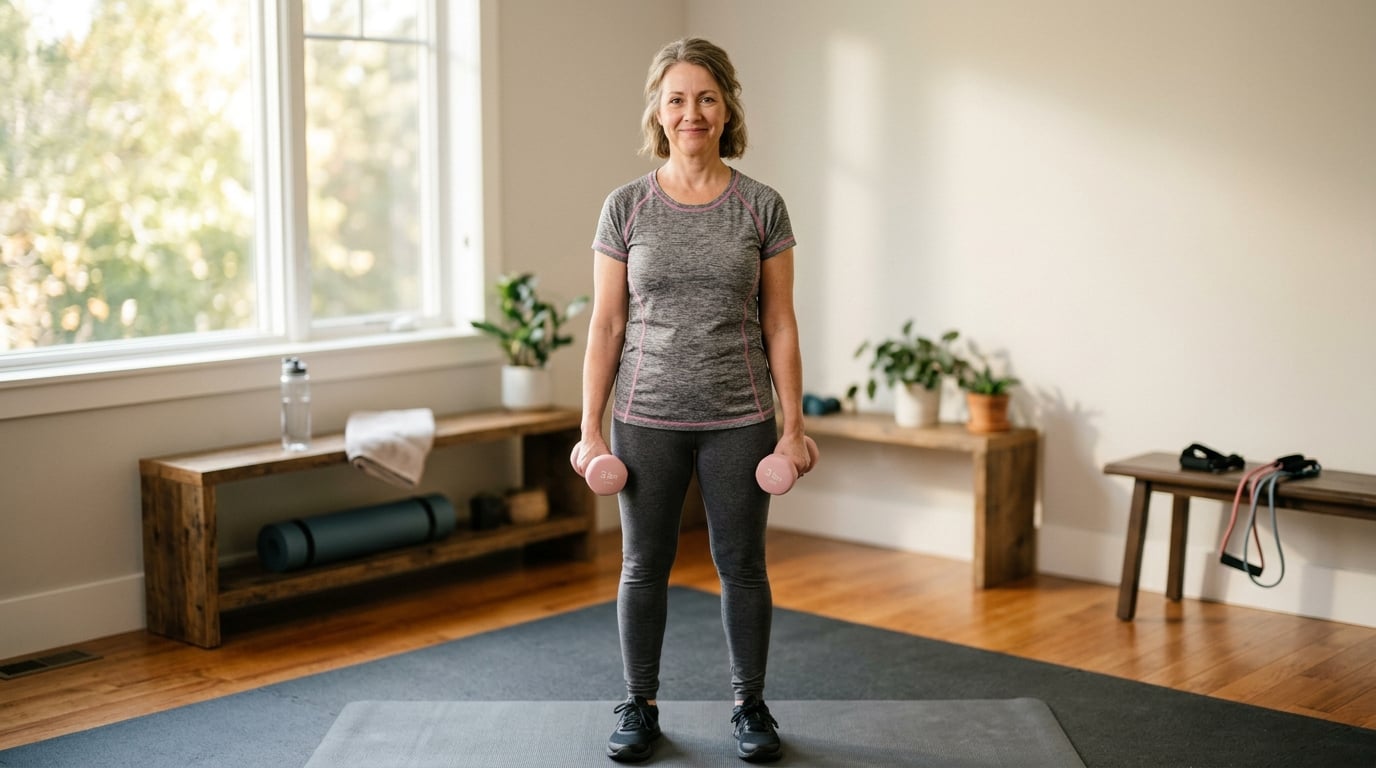
There is no rule that says you must start in a gym. A pair of dumbbells in your living room is a perfectly valid, powerful place to begin. Build a little confidence and strength at home, and the gym will feel far less intimidating when — or if — you decide to go.
4. Focus on how you feel, not how you look
In the early weeks, the scale and the mirror are the least reliable measures of progress. Notice instead how you're sleeping better, climbing stairs more easily, feeling a little more energetic. These early wins are what keep you going long enough for the visible changes to catch up.
What to Expect in Your First Month
The first two weeks will feel unfamiliar. That's normal. You might be a little sore, a little unsure, and tempted to quit. Push gently through it. By week three, something shifts — the movements start to feel more natural, you begin to look forward to sessions, and you notice you're a bit stronger. By the end of the first month, you'll have proven something profound to yourself: that you are someone who shows up. That identity is worth more than any single workout.
Common Fears, Answered Honestly
- "I'm too unfit to start." There is no fitness prerequisite for beginning. Everyone starts from wherever they are. That's the whole point.
- "I'll get too bulky." Women simply don't build large amounts of muscle easily, especially after 40. Strength training gives you a toned, capable, strong body — not a bulky one.
- "It's too late for me." Research shows women can build significant strength and muscle well into their 60s, 70s, and beyond. It is never, ever too late.
- "I'll look silly." You'll look like a woman investing in her health and future. There is nothing silly about that — it's one of the most admirable things you can do.
The Bottom Line
Starting is the hardest part — and you only have to do it once. Everything after that first session is just showing up again, a little braver and a little stronger each time. You don't need to be fit to begin. You don't need to know everything. You don't need to feel ready, because ready is a feeling that arrives after you start, not before.
The woman you want to become is on the other side of that first awkward, scary, brilliant step. Take it this week. Start smaller than feels impressive, be kind to yourself, and keep showing up. Your strong era doesn't begin when you feel confident — it begins the moment you decide to start anyway.
Free Protein Cheat Sheet
Your daily protein target, the protein in 40+ everyday foods, and 25 easy high-protein snacks — all on one printable page.
🔒 No spam, ever. Unsubscribe anytime.
Want personalised help with this?
My 1:1 online coaching gives you a fully custom training and nutrition plan built around your goals, your body, and your life. 12 weeks, $69/week, with me in your corner the whole way.
Learn About CoachingFree 7-Day Fat Loss Meal Plan
A printable week of protein-forward meals, shopping list, meal prep guide and tracker — designed for women over 40.