How to Get Strong at Home with Minimal Equipment
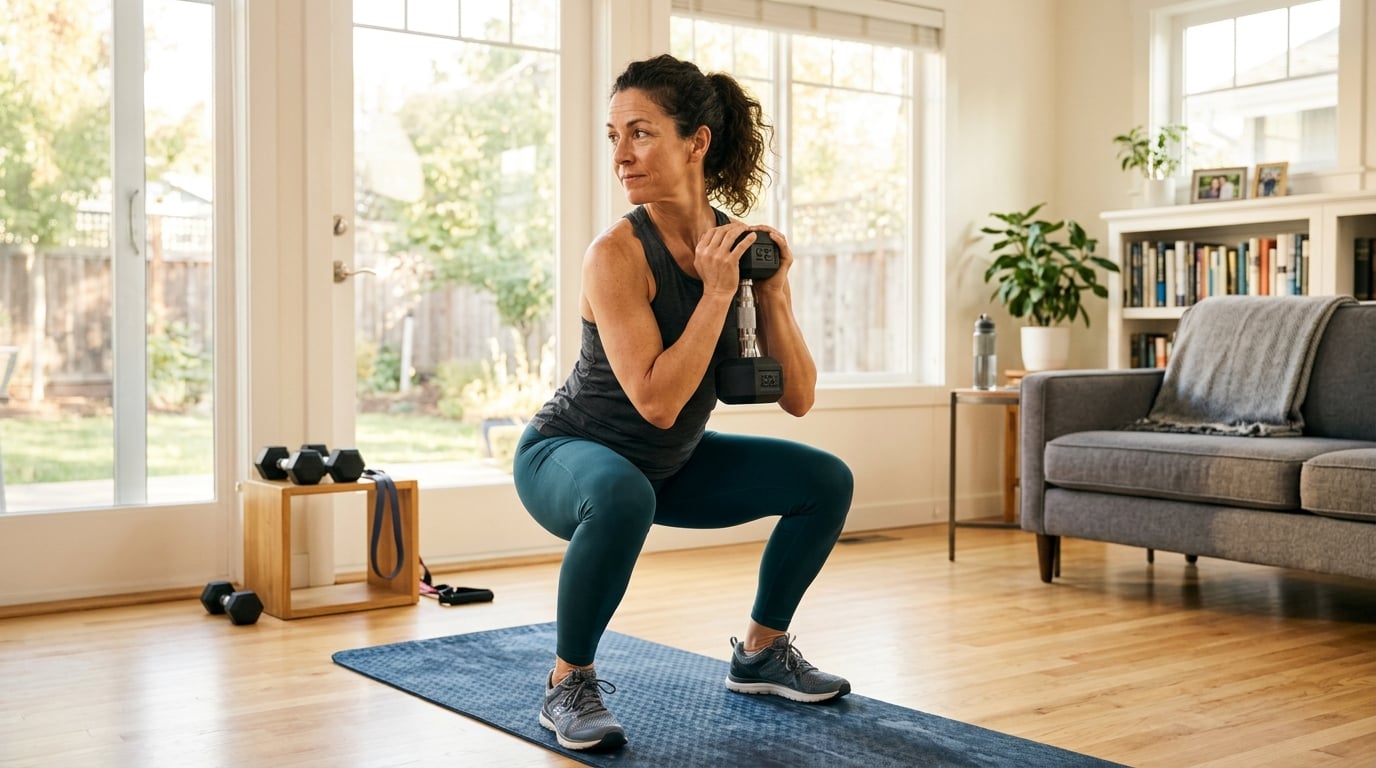
Let me bust a myth that needs to die: you do not need a gym membership to get strong. You don't need a room full of machines, a cable stack, or a squat rack to build muscle, lose fat, and feel incredible after 40. Some of the strongest, most consistent women I coach train entirely from home — with nothing more than a pair of dumbbells and their own bodyweight.
Don't get me wrong, gyms are great. But if the gym feels intimidating, inconvenient, expensive, or just isn't your thing — that should never be a barrier to starting your strong era. Your living room, garage, garden, or spare bedroom can be your training ground. And the results? They can be just as impressive.
Free 7-Day Beginner Strength Plan
Three simple full-body dumbbell workouts with form cues, warm-ups and rest days built in — designed for women over 40.
🔒 No spam, ever. Unsubscribe anytime.
What You Actually Need
Let's keep this simple. To build an effective home gym for strength training after 40, you need:
A set of adjustable dumbbells or 2-3 pairs of fixed dumbbells. For most women starting out, having a light pair (3-5 kg), a medium pair (7-10 kg), and a heavier pair (12-15 kg) covers the majority of exercises. As you progress, you can add heavier weights. Adjustable dumbbells are more cost-effective and take up less space.
A resistance band set (optional but valuable). Bands are inexpensive, portable, and add variety to your training. They're especially useful for warm-ups, glute activation, and upper body exercises where lighter resistance is needed.
An exercise mat. For floor work — core exercises, stretches, and any lying or kneeling movements. Your knees and back will thank you.
A stable chair or bench. A sturdy dining chair or even a staircase can serve as a bench for step-ups, elevated push-ups, tricep dips, hip thrusts, and split squats.
That's it. Total investment: somewhere between $100 and $300 depending on what you buy. Less than three months of most gym memberships. And it lasts forever.
Why Home Training Works So Well for Women Over 40
There's a practical reason home training is so effective for women in midlife: it removes barriers. No commute time. No gym anxiety. No waiting for equipment. No worrying about what you look like or whether you're doing it "right" in front of strangers. You roll out of bed, put on your gear, and you're training within minutes.
For busy women juggling work, family, and everything else that comes with this season of life, that elimination of friction is everything. The best workout programme in the world is useless if you can't consistently do it. A simple home routine you do three times a week will always outperform a complex gym programme you do twice a month.
There's also a psychological benefit. Training at home builds a sense of ownership over your fitness. It becomes yours — not something you go to, but something you do. That shift in identity is powerful.
The Best Home Exercises for Strength After 40
You don't need dozens of exercises. You need the right ones, done well and progressed over time. Here are the essential movements that cover all major muscle groups with minimal equipment:
Lower Body
Goblet Squat: Hold a dumbbell at your chest, squat to depth, and drive back up. This builds your quads, glutes, and core while teaching beautiful squat mechanics. It's the single best lower body exercise for home training.
Romanian Deadlift (RDL): Hold dumbbells in front of your thighs, hinge at the hips, and lower the weights while keeping your back flat. This targets your hamstrings, glutes, and lower back — the entire posterior chain that keeps you strong and upright.
Reverse Lunge: Step one foot back, lower your knee towards the floor, and push back up. Builds single-leg strength, balance, and hip stability. Hold dumbbells by your sides for added resistance.
Glute Bridge / Hip Thrust: Lie on your back with feet flat, drive your hips up, and squeeze your glutes at the top. Elevate your upper back on a chair or step to increase the range of motion. Place a dumbbell across your hips for progressive overload.
Upper Body
Dumbbell Row: Place one hand and knee on a chair, row a dumbbell towards your hip with the other arm. This builds your back, improves posture, and balances out all the forward-leaning we do in daily life.
Dumbbell Floor Press: Lie on your back, press dumbbells up from chest level. Without a bench, the floor limits your range but still provides an excellent chest, shoulder, and tricep workout. It's actually gentler on the shoulders, which is a bonus for women with shoulder sensitivities.
Overhead Press: Standing or seated, press dumbbells from shoulder height to overhead. Builds strong shoulders, upper back, and core stability. Start light and focus on controlled movement.
Push-Ups (Modified if Needed): The king of bodyweight exercises. Start on your knees if needed, progress to full push-ups over time. Push-ups work your chest, shoulders, triceps, and core simultaneously.
Core
Dead Bug: Lie on your back, extend opposite arm and leg while keeping your lower back pressed into the floor. This is a safer, more effective core exercise than sit-ups — especially for women who've had children or have any pelvic floor considerations.
Plank: Classic but effective. Hold for 20-30 seconds with perfect form rather than wobbling through 2 minutes. Quality over quantity.
Pallof Press: Using a resistance band anchored to a door handle, press the band straight out from your chest and resist rotation. This anti-rotation exercise builds deep core stability that translates directly to real life.
A Sample 3-Day Home Workout Week
Here's what a structured week could look like. Each session takes 30-40 minutes including warm-up.
Day 1 — Lower Body Focus:
- Warm-up: hip circles, bodyweight squats, glute bridges (3 minutes)
- Goblet Squats: 3 sets of 10-12
- Romanian Deadlifts: 3 sets of 10-12
- Reverse Lunges: 3 sets of 10 each leg
- Glute Bridges (weighted): 3 sets of 12-15
- Dead Bugs: 3 sets of 10 each side
Day 2 — Upper Body Focus:
- Warm-up: arm circles, band pull-aparts, wall push-ups (3 minutes)
- Dumbbell Rows: 3 sets of 10-12 each arm
- Dumbbell Floor Press: 3 sets of 10-12
- Overhead Press: 3 sets of 8-10
- Push-Ups: 3 sets of as many as you can with good form
- Plank: 3 sets of 20-30 seconds
Day 3 — Full Body:
- Warm-up: hip circles, thoracic rotations, bodyweight squats (3 minutes)
- Goblet Squats: 3 sets of 10
- Dumbbell Rows: 3 sets of 10 each arm
- Reverse Lunges: 3 sets of 8 each leg
- Dumbbell Floor Press: 3 sets of 10
- Romanian Deadlifts: 3 sets of 10
- Pallof Press: 3 sets of 10 each side
Rest 60-90 seconds between sets. Focus on controlled movement — 2-3 seconds lowering, a brief pause, then push or pull with power. This tempo maximises muscle engagement and minimises injury risk.
How to Progress Without a Gym
Progressive overload — gradually making your training harder over time — is the key to continued results. Without a full gym, you might think progression is limited. It's not. Here's how to keep challenging yourself:
- Increase the weight. The most obvious option. When 10 reps feels comfortable, go heavier.
- Add reps. If you can't increase weight, go from 10 reps to 12, then 15.
- Slow down the tempo. A 4-second lower on every squat is dramatically harder than a fast rep.
- Add pauses. Hold the bottom of a squat for 2 seconds. Pause at the top of a hip thrust. These eliminate momentum and force your muscles to work harder.
- Reduce rest periods. Going from 90 seconds rest to 60 seconds increases the metabolic demand.
- Add a set. Going from 3 sets to 4 adds volume without needing heavier weights.
- Single-leg or single-arm variations. A single-leg Romanian deadlift is significantly harder than the bilateral version — and you might find your lighter dumbbells suddenly feel very heavy.
Common Home Training Mistakes
Don't train the same way forever. If you've been doing the same weights and reps for months, your body has adapted and progress has stalled. Use the progression strategies above to keep things challenging.
Don't skip the warm-up. At home it's tempting to just start lifting straight away. Spend 3-5 minutes warming up your joints and muscles. It reduces injury risk and actually improves performance during the session.
Don't rely on YouTube for programming. Random workouts every day without structure, progression, or balance will give you random results. Follow a programme, even a simple one, and stick with it for at least 6-8 weeks before changing.
Don't underestimate what you can achieve. Home training isn't "less than" gym training. It's different, but for most women who want to get strong, lose fat, and feel amazing — it's more than enough. The best programme is the one you actually do.
Your Living Room, Your Rules
There's something beautifully empowering about training in your own space. No one watching, no one judging, no commute, no excuses. Just you, your dumbbells, and 30 minutes of doing something powerful for yourself.
You don't need permission from a gym to get strong. You don't need expensive equipment or a perfectly set up home gym. You need a plan, a pair of dumbbells, and the willingness to show up consistently.
This is your space. This is your time. And this is your strong era — wherever you choose to train.
Free 7-Day Beginner Strength Plan
Three simple full-body dumbbell workouts with form cues, warm-ups and rest days built in — designed for women over 40.
🔒 No spam, ever. Unsubscribe anytime.
Want personalised help with this?
My 1:1 online coaching gives you a fully custom training and nutrition plan built around your goals, your body, and your life. 12 weeks, $69/week, with me in your corner the whole way.
Learn About CoachingFree 7-Day Fat Loss Meal Plan
A printable week of protein-forward meals, shopping list, meal prep guide and tracker — designed for women over 40.