Pelvic Floor Health for Women Over 40: The Muscle Group You Cannot Ignore
Let us talk about something most women were never taught to think about — until it started causing problems. Your pelvic floor. It is the quiet, hard-working hammock of muscles at the base of your pelvis, and for far too long it has been the most ignored muscle group in women's health. We whisper about it. We laugh nervously about crossing our legs when we sneeze. But here is the truth: your pelvic floor deserves the same attention, respect and training as any other muscle in your body — arguably more so after 40.
If you have ever leaked a little when you laughed, coughed or jumped, felt a heaviness or pressure down there, or noticed changes since having children or entering perimenopause, you are absolutely not alone — and you are certainly not broken. These are common experiences, but common does not mean you have to live with them. With the right knowledge and a few minutes of consistent practice, the pelvic floor can be strengthened, coordinated and restored at any age. Let me show you how.
Free Protein Cheat Sheet
Your daily protein target, the protein in 40+ everyday foods, and 25 easy high-protein snacks — all on one printable page.
🔒 No spam, ever. Unsubscribe anytime.
What Exactly Is Your Pelvic Floor?
Picture a supportive sling of muscles stretching from your pubic bone at the front to your tailbone at the back, and side to side between your sitting bones. This is your pelvic floor. It has several vital jobs that quietly hold your life together:
- Support. It holds up your bladder, bowel and uterus, keeping everything where it should be.
- Control. It manages the opening and closing of your bladder and bowel — which is why weakness can lead to leaks.
- Core stability. It works as part of your deep core team, supporting your spine and posture with every movement.
- Sexual function and sensation. A healthy, responsive pelvic floor plays an important role here too.
Why It Changes After 40
Several things converge in midlife that make pelvic floor care essential rather than optional. Understanding them takes away the shame and hands you back control:
Declining Oestrogen
As you move through perimenopause and menopause, falling oestrogen levels affect the strength and elasticity of the pelvic floor tissues, just as they affect skin and other tissues. This can make the muscles feel weaker or less responsive.
The Legacy of Pregnancy and Birth
If you have carried and birthed babies, your pelvic floor has already done extraordinary work. Sometimes that leaves lasting changes that only become noticeable years later, particularly as other factors stack up.
General Muscle Loss
Just like every other muscle, the pelvic floor loses tone and strength with age if it is not challenged. The good news is identical too — it responds to training.
The Signs Your Pelvic Floor Needs Attention
Your body sends signals. Learning to read them means you can act early rather than simply coping. Watch for:
- Leaking urine when you cough, sneeze, laugh, jump or run.
- A sudden, urgent need to rush to the loo, or going very frequently.
- A feeling of heaviness, dragging or pressure in the pelvic area.
- Reduced sensation or a feeling that things are not as supported as they once were.
- Lower back or pelvic discomfort that has no other obvious cause.
If any of these feel familiar, please know two things: it is very common, and it is very treatable. If symptoms are significant or distressing, a women's health physiotherapist is worth their weight in gold and I always recommend seeing one.
How to Do a Proper Pelvic Floor Contraction
Most women have heard of pelvic floor exercises, but many are doing them incorrectly — or holding their breath and squeezing everything at once. Here is how to find and train the right muscles properly:
- Find the muscles. Imagine you are trying to stop yourself passing wind and stop the flow of urine at the same time. That gentle lift and squeeze inwards and upwards is your pelvic floor engaging. It should feel like an internal lift, not a clench of your buttocks or thighs.
- Keep breathing. Never hold your breath. Breathe normally throughout — the pelvic floor works beautifully in rhythm with your breath.
- Relax fully. The release is just as important as the lift. A healthy pelvic floor can both contract and fully let go. Do not skip the relaxation phase.
Five Simple Pelvic Floor Exercises to Try
You do not need any equipment, and you can do most of these anywhere — at your desk, in the car, or lying in bed. Consistency matters far more than intensity here. A few minutes daily beats an occasional marathon session.
1. Slow Lifts (Endurance)
Gently lift and squeeze your pelvic floor, hold for a count of five while breathing normally, then fully release for five. Build up to holding for ten seconds. Aim for 8 to 10 repetitions. This trains the muscles that provide steady, all-day support.
2. Quick Flicks (Strength & Reflex)
Perform fast, strong contractions — a quick lift and immediate release. These train the reflex your pelvic floor needs for those sudden moments of coughing or sneezing. Aim for 10 quick flicks.
3. The Knack
This is a game changer for leaks. Learn to consciously lift and squeeze your pelvic floor a split second before you cough, sneeze, lift something heavy or laugh. Bracing in advance protects you and, over time, becomes automatic.
4. Bridges with Breath
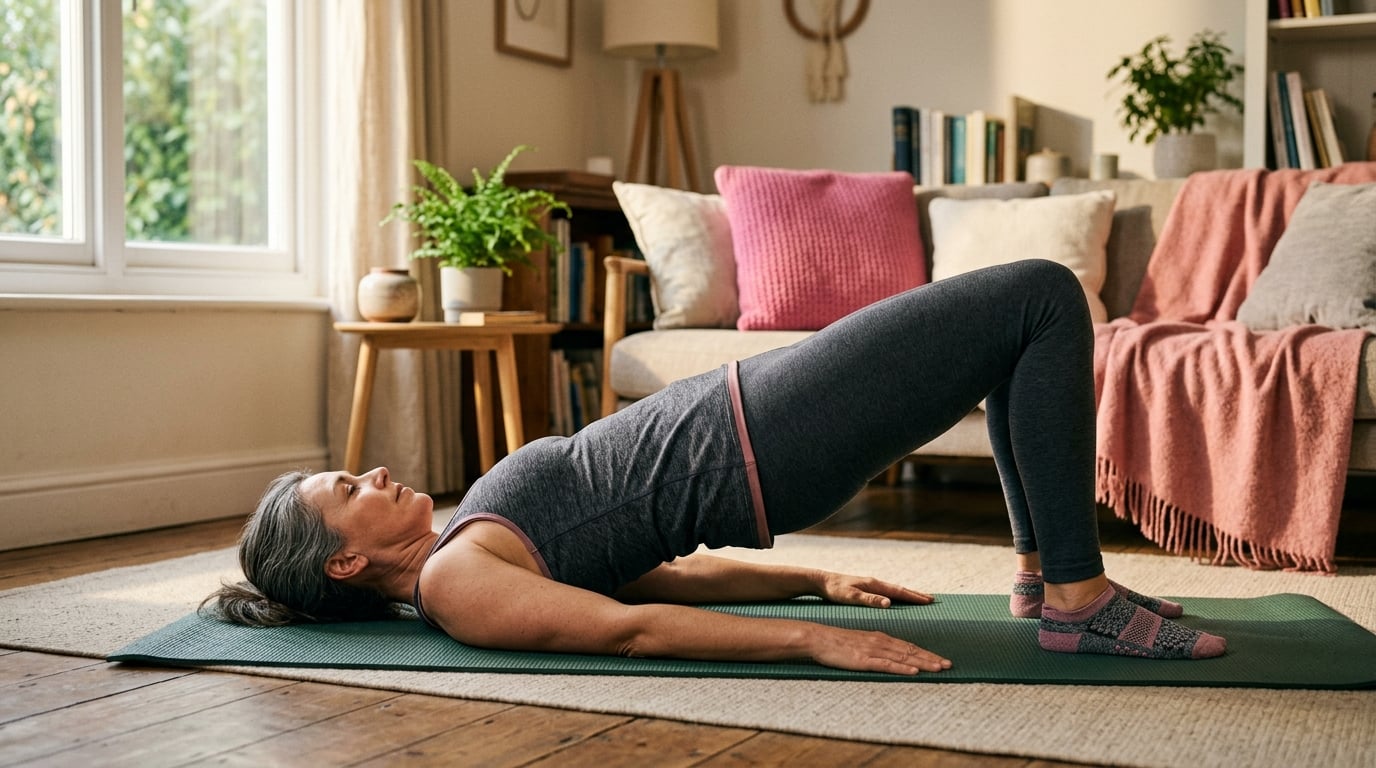
Lie on your back, knees bent. As you exhale, gently engage your pelvic floor and lift your hips into a bridge. Inhale and lower with control, releasing the pelvic floor. This connects your pelvic floor to your glutes and deep core — the way it is meant to work in real life.
5. Deep Core Breathing
Sit or lie comfortably. As you breathe in, let your belly and pelvic floor gently expand and relax. As you breathe out, softly draw your lower belly in and lift your pelvic floor. This restores the natural coordination between your breath, deep core and pelvic floor.
Everyday Habits That Help
Training is only part of the picture. A few simple lifestyle tweaks protect and support your pelvic floor every single day:
- Do not push or strain on the toilet — take your time and let things happen naturally.
- Stay well hydrated. Ironically, cutting back on fluids irritates the bladder and makes urgency worse.
- Look after your gut. Constipation and straining place real pressure on the pelvic floor, so plenty of fibre helps.
- Lift with awareness. Engage your pelvic floor and exhale as you lift anything heavy, rather than holding your breath and bearing down.
- Keep moving. A strong, mobile body with good posture supports pelvic floor function overall.
Be Patient and Kind to Yourself
Pelvic floor muscles respond to training just like any others, but change takes time — usually a good three to five months of consistency before you notice real, lasting improvement. Do not be discouraged if progress feels slow. Every gentle lift is building strength beneath the surface.
Most of all, let go of any embarrassment. This is your body, these are your muscles, and caring for them is one of the most powerful, loving things you can do for yourself in midlife and beyond. A strong pelvic floor means confidence to laugh freely, move boldly and live fully — without a second thought. That is what your strong era is all about.
Free Protein Cheat Sheet
Your daily protein target, the protein in 40+ everyday foods, and 25 easy high-protein snacks — all on one printable page.
🔒 No spam, ever. Unsubscribe anytime.
Want personalised help with this?
My 1:1 online coaching gives you a fully custom training and nutrition plan built around your goals, your body, and your life. 12 weeks, $69/week, with me in your corner the whole way.
Learn About CoachingFree 7-Day Fat Loss Meal Plan
A printable week of protein-forward meals, shopping list, meal prep guide and tracker — designed for women over 40.