Resistance Band Exercises for Women Over 40: Your Full-Body Workout in a Handbag
If I could recommend just one piece of equipment to every woman over 40, it would not be a set of dumbbells, a kettlebell or a gym membership. It would be a resistance band. A simple loop of stretchy rubber that fits in your handbag, costs less than a takeaway coffee, and can deliver a genuinely challenging, full-body workout anywhere you happen to be. Sounds too good to be true? Let me change your mind.
Resistance bands are one of the most underrated training tools in fitness, and they are particularly brilliant for women in midlife. They are gentle on joints, endlessly adaptable, and they create tension through the entire range of movement — something even free weights cannot always do. Whether you are brand new to strength training or you have been lifting for years, bands add a dimension to your workouts that builds muscle, improves stability and keeps things interesting. Here is everything you need to know to get started.
Free 7-Day Beginner Strength Plan
Three simple full-body dumbbell workouts with form cues, warm-ups and rest days built in — designed for women over 40.
🔒 No spam, ever. Unsubscribe anytime.
Why Resistance Bands Are Perfect After 40
There are some very specific reasons bands suit us so well at this stage of life. Understanding them helps you see why they are not a compromise — they are a genuine advantage:
- Joint-friendly tension. Bands create smooth, continuous resistance without the jarring impact of heavy weights. This is ideal when joints are a little stiffer or more sensitive than they used to be.
- Progressive challenge. You can increase difficulty simply by choosing a thicker band, shortening the loop, or doubling it. No need to buy a whole rack of dumbbells.
- Constant tension. Unlike a dumbbell where gravity does some of the work, a band keeps tension on the muscle throughout the entire movement — which means more activation with lighter loads.
- Portability. Bands weigh next to nothing and take up zero space. Travel, outdoor workouts, hotel rooms, your living room — no excuses, ever.
- Stability and balance. Because bands pull in different planes, your stabiliser muscles have to work harder. This builds the kind of functional strength that keeps you steady on your feet.
Choosing the Right Band
Bands come in different shapes, but for the exercises below I recommend a simple loop band (a continuous circle, sometimes called a mini band or booty band). Here is a quick guide to resistance levels:
- Light (thin): Perfect for warm-ups, upper body work and learning movements.
- Medium: The workhorse for most exercises. This is where you will spend most of your time.
- Heavy (thick): Great for lower body power moves like squats and hip thrusts once you have built a base.
Ideally, grab a set of three so you can match the band to the exercise. A light band for pull-aparts and a heavy one for squats makes a big difference.
Seven Resistance Band Exercises for a Full-Body Workout
These seven moves cover your entire body — legs, glutes, back, shoulders, arms and core. You can do them as a circuit (one after the other with a short rest) or pick four or five for a focused session. All you need is a band and a little space.
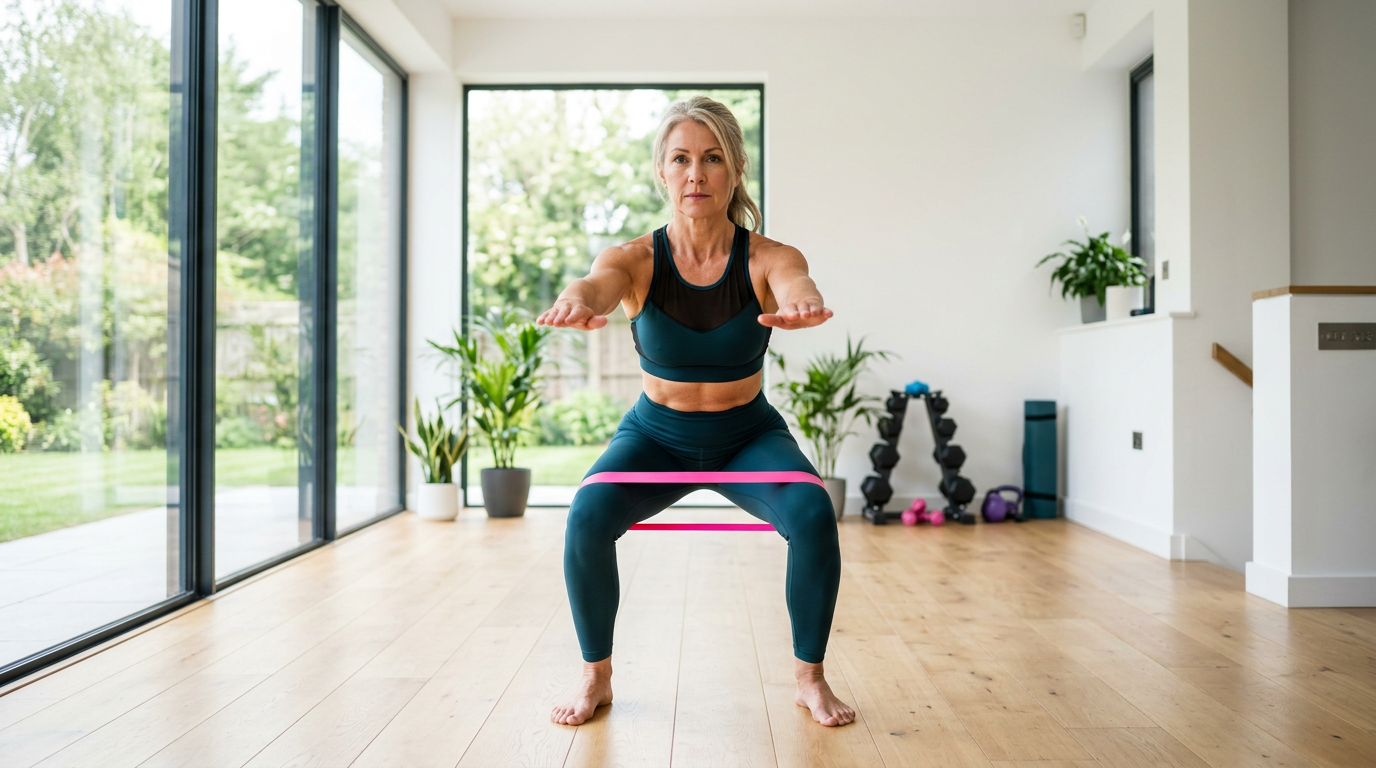
1. Banded Squats
Place the band just above your knees. Stand with feet hip-width apart, toes slightly turned out. As you squat down, actively press your knees outward against the band — this fires up your glutes far more than a regular squat. Push through your heels to stand. Aim for 3 sets of 12.
2. Lateral Band Walks
Band above the knees, sink into a quarter squat and take controlled steps sideways, keeping tension on the band throughout. These are a hip-stabiliser powerhouse and brilliant for knee health. Take 10 steps each direction for 3 sets.
3. Banded Glute Bridges
Lie on your back, band above knees, feet flat. Lift your hips and press your knees apart against the band at the top. Squeeze your glutes hard, pause, then lower with control. The band turns a great exercise into an incredible one. Aim for 3 sets of 15.
4. Pull-Aparts
Hold the band in front of you at shoulder height with both hands, arms straight. Pull the band apart by squeezing your shoulder blades together, then slowly return. This is magic for posture — especially if you spend time at a desk. Aim for 3 sets of 15.
5. Banded Rows
Sit on the floor with legs extended. Loop the band around your feet and hold both sides. Pull towards your ribs, squeezing your back muscles, then release with control. A brilliant back builder with zero equipment needed beyond the band. Aim for 3 sets of 12.
6. Overhead Press with Band
Stand on the band with both feet and hold the top of the loop at shoulder height. Press straight up overhead, then lower slowly. This challenges your shoulders and arms with smooth, joint-friendly resistance. Aim for 3 sets of 10.
7. Banded Dead Bugs
Lie on your back with the band looped around your feet. Arms up, knees at 90 degrees. Slowly extend one leg and the opposite arm, keeping the band taut and your lower back pressed into the floor. This is deep core work that connects beautifully with pelvic floor health. Aim for 3 sets of 8 per side.
A Simple 20-Minute Band Workout
Short on time? This circuit takes just 20 minutes and hits everything. Perform each exercise for 40 seconds, rest 20 seconds, then move to the next. Complete 3 rounds with a one-minute rest between rounds:
- Banded Squats
- Pull-Aparts
- Lateral Band Walks
- Banded Glute Bridges
- Banded Rows
- Banded Dead Bugs
Tips for Getting the Most From Your Bands
- Control the return. The eccentric (lowering) phase is where a lot of the muscle-building happens. Do not let the band snap back — control it.
- Keep constant tension. If the band goes slack at any point, you have lost the benefit. Adjust your position or use a thicker band.
- Combine with bodyweight or weights. Bands are not an either/or choice. Adding a band to your regular squats, bridges or presses makes them more challenging without adding joint stress.
- Check for wear. Inspect your bands regularly for nicks or thin spots. A snapped band mid-rep is no fun at all.
Start Simple, Stay Consistent
You do not need a perfect set-up or a complicated programme. One band, three or four exercises, fifteen to twenty minutes, two or three times a week — that is enough to build real, noticeable strength. The beauty of bands is that they meet you exactly where you are and grow with you as you get stronger.
So throw one in your bag, take it on holiday, keep one by the sofa. Remove every barrier between you and a quick session, and watch what consistency does over the next few months. Your strong era does not require a gym — just a band and the decision to show up.
Free 7-Day Beginner Strength Plan
Three simple full-body dumbbell workouts with form cues, warm-ups and rest days built in — designed for women over 40.
🔒 No spam, ever. Unsubscribe anytime.
Want personalised help with this?
My 1:1 online coaching gives you a fully custom training and nutrition plan built around your goals, your body, and your life. 12 weeks, $69/week, with me in your corner the whole way.
Learn About CoachingFree 7-Day Fat Loss Meal Plan
A printable week of protein-forward meals, shopping list, meal prep guide and tracker — designed for women over 40.