Upper Body Strength for Women Over 40: Build Confidence From the Shoulders Down
If there is one area of training that women over 40 tend to avoid, it is upper body work. Maybe you have spent years focused on legs and cardio. Maybe you worry about getting "bulky." Maybe you have never been shown how. Whatever the reason, here is what I want you to hear: building upper body strength after 40 is not just about looking toned in a sleeveless top. It is about independence, injury prevention, and feeling genuinely powerful in your own skin.
Think about your daily life: lifting groceries, carrying luggage, pushing open heavy doors, picking up grandchildren, reaching overhead, getting yourself off the floor. Every one of those tasks requires upper body strength. And as we age, that strength declines faster than we realise — unless we intentionally build and maintain it.
Free 7-Day Beginner Strength Plan
Three simple full-body dumbbell workouts with form cues, warm-ups and rest days built in — designed for women over 40.
🔒 No spam, ever. Unsubscribe anytime.
Why Upper Body Strength Declines After 40
Women naturally carry less upper body muscle mass than men, and after 40, the decline accelerates:
- Sarcopenia — the age-related loss of muscle mass affects the upper body disproportionately, especially the shoulders, arms, and back.
- Hormonal shifts — declining oestrogen reduces muscle protein synthesis, making it harder (but not impossible) to build and maintain muscle.
- Years of undertraining — many women have spent decades doing cardio and lower body work while largely ignoring their upper body. The result is a significant strength imbalance that becomes harder to ignore with age.
- Postural changes — decades of desk work, phone use, and forward-leaning postures weaken the upper back and shoulders, contributing to rounded shoulders, neck pain, and reduced mobility.
The good news? Muscle responds to training at any age. Research consistently shows that women in their 40s, 50s, 60s, and beyond can build significant upper body strength with the right programme.
The Benefits Go Far Beyond Aesthetics
Functional Independence
Strong arms, shoulders, and back mean you can carry your own bags, open your own jars, rearrange your own furniture, and handle daily tasks without depending on anyone else. That independence is priceless.
Injury Prevention
Strong shoulders and upper back muscles protect your rotator cuffs — one of the most commonly injured areas in women over 40. Strong muscles around your joints act as shock absorbers and stabilisers, dramatically reducing injury risk.
Better Posture
Training your upper back (rhomboids, middle and lower trapezius, rear deltoids) counteracts the forward-hunching pattern from years of sitting. Better posture means less neck pain, fewer headaches, and yes — you stand taller and look more confident.
Bone Density
Upper body strength training loads the bones of your spine, arms, and wrists — areas particularly vulnerable to osteoporosis in women. Weight-bearing exercise is one of the most effective ways to maintain and even build bone density after 40.
Metabolic Health
More muscle mass means a higher resting metabolic rate. Your upper body contains large muscle groups (back, chest, shoulders) that, when trained, contribute significantly to overall calorie burn — even at rest.
Essential Upper Body Exercises for Women Over 40
You do not need a gym full of machines. These fundamental movements cover every major upper body muscle group:
Push Movements (Chest, Shoulders, Triceps)
- Push-ups — start from an incline (hands on a bench or wall) if floor push-ups are too challenging. Work towards the floor over time. 3 sets of 8–12.
- Overhead press — dumbbells or a barbell, standing or seated. Press from shoulder height to overhead. Builds strong, capable shoulders. 3 sets of 8–10.
- Chest press — lying on a bench with dumbbells. Press up from chest level. Builds chest and front shoulder strength. 3 sets of 10–12.
Pull Movements (Back, Biceps)
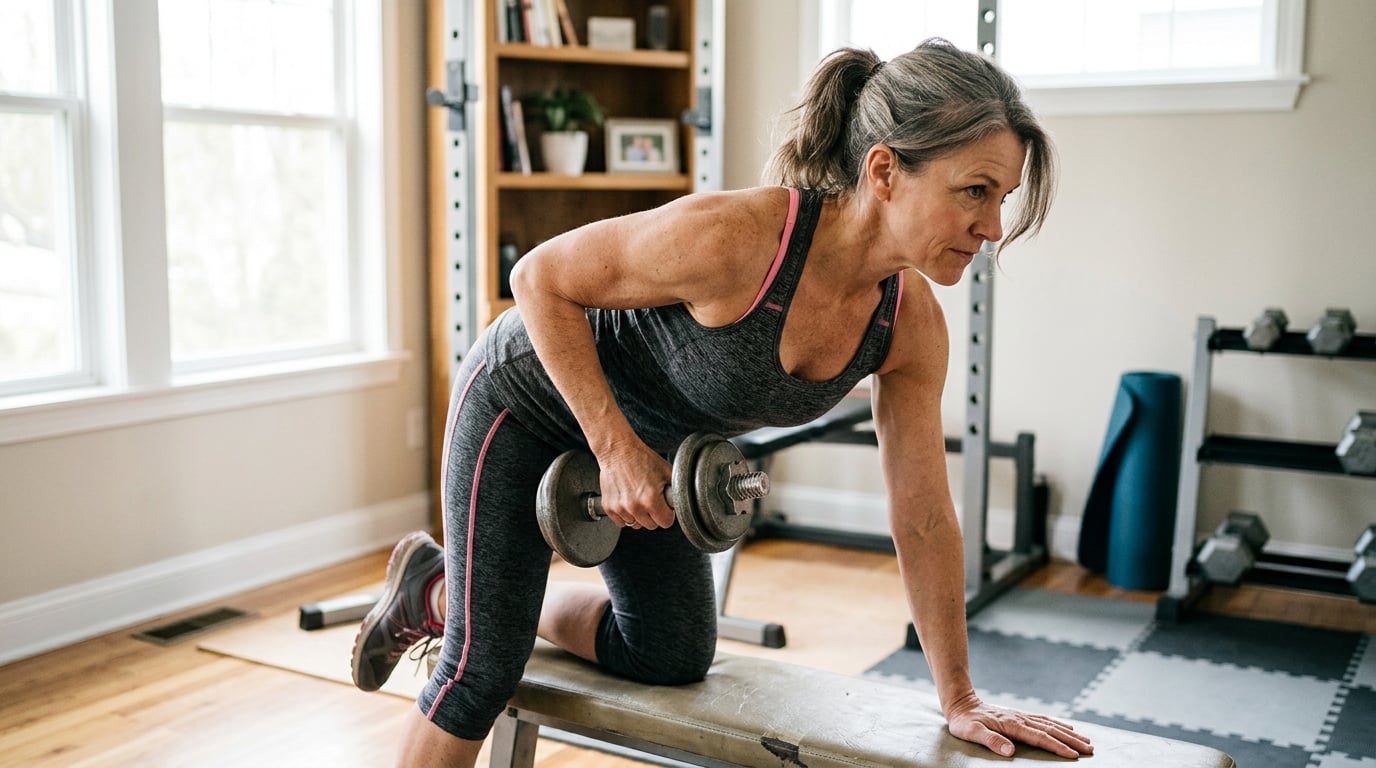
- Rows — single-arm dumbbell rows, cable rows, or barbell rows. These are your bread and butter for a strong, healthy back. 3 sets of 10–12 per side.
- Lat pulldowns — if you do not have access to a pull-up bar, lat pulldowns build the same muscles. Pull the bar to your upper chest, not behind your neck. 3 sets of 10–12.
- Face pulls — using a cable or resistance band at face height, pull towards your forehead with elbows high. Incredible for posture and shoulder health. 3 sets of 15.
Shoulder Stability
- Lateral raises — light dumbbells, raise to shoulder height. Builds the medial deltoid for shoulder width and stability. 3 sets of 12–15.
- Band pull-aparts — hold a resistance band at chest height and pull it apart. Strengthens the rear shoulders and upper back. 3 sets of 15–20.
Arm Strength
- Bicep curls — dumbbells or a barbell. Simple, effective, and yes — there is nothing wrong with wanting strong arms. 3 sets of 10–12.
- Tricep dips or overhead extensions — the backs of your arms. Use a bench for dips (modified) or a dumbbell for overhead extensions. 3 sets of 10–12.
A Simple Upper Body Training Plan
Train your upper body two days per week with at least 48 hours between sessions. Here is a balanced split:
Day 1 — Push Focus
- Push-ups (incline or floor): 3 × 8–12
- Overhead press: 3 × 8–10
- Lateral raises: 3 × 12–15
- Tricep dips or extensions: 3 × 10–12
Day 2 — Pull Focus
- Rows (any variation): 3 × 10–12
- Lat pulldowns: 3 × 10–12
- Face pulls: 3 × 15
- Bicep curls: 3 × 10–12
- Band pull-aparts: 3 × 15–20
Each session takes about 30–35 minutes. Pair it with your lower body and core work on other days for a complete programme.
Common Concerns (and Why You Can Let Them Go)
"I do not want to get bulky"
You will not. Women do not have the testosterone levels required to build large, bulky muscles. What you will build is lean, defined, functional muscle that looks and feels strong — not bulky.
"I have shoulder pain — should I avoid upper body training?"
In most cases, the right upper body training actually reduces shoulder pain by strengthening the muscles around the joint. Start lighter, focus on form, and prioritise pulling movements (rows, face pulls) to build the stabilising muscles first. If pain persists, see a physiotherapist.
"I cannot even do one push-up"
That is completely fine. Start with wall push-ups, then move to incline push-ups on a bench. Progress gradually. Every strong woman started exactly where you are now.
"Is it too late to start?"
Absolutely not. Research shows measurable strength gains in women who begin resistance training in their 50s, 60s, and even 70s. It is never too late. The best time to start was 20 years ago. The second-best time is today.
Your Arms Were Built to Be Strong
You were not designed to struggle with heavy doors, strain to lift suitcases into overhead lockers, or feel helpless opening a stubborn jar. Your upper body was built for strength — it has just been waiting for the right stimulus.
Give it that stimulus. Start with what you can manage today. Add a little more next week. And watch what happens when a woman over 40 decides her arms, shoulders, and back deserve the same attention she has been giving everyone else.
That is your strong era. And it is going to feel incredible.
Free 7-Day Beginner Strength Plan
Three simple full-body dumbbell workouts with form cues, warm-ups and rest days built in — designed for women over 40.
🔒 No spam, ever. Unsubscribe anytime.
Want personalised help with this?
My 1:1 online coaching gives you a fully custom training and nutrition plan built around your goals, your body, and your life. 12 weeks, $69/week, with me in your corner the whole way.
Learn About CoachingFree 7-Day Fat Loss Meal Plan
A printable week of protein-forward meals, shopping list, meal prep guide and tracker — designed for women over 40.