The 5-Minute Morning Stretch Routine That Changes Everything After 40
You know that feeling when you wake up and everything is stiff? Your back aches, your shoulders are up around your ears, and bending down to feed the cat feels like a whole event? After 40, mornings can feel like your body needs a good half hour just to warm up and come online.
Here is the thing: it does not have to be that way. A simple five-minute stretch routine — done before your morning coffee — can genuinely transform how you feel for the rest of the day. We are not talking about an hour-long yoga class or anything complicated. Just five minutes of gentle, purposeful movement to wake up your muscles, lubricate your joints and release the stiffness that builds overnight.
I do this every single morning and the difference is night and day. Here is the exact routine.
Free 7-Day Beginner Strength Plan
Three simple full-body dumbbell workouts with form cues, warm-ups and rest days built in — designed for women over 40.
🔒 No spam, ever. Unsubscribe anytime.
Why Morning Stretching Matters After 40
While you sleep, your body is relatively still for 6–8 hours. During that time, fluid pools around your joints, muscles cool and shorten, and fascia (the connective tissue that wraps everything) stiffens. This is completely normal — but after 40, it becomes more pronounced because of declining oestrogen, reduced collagen production and less elastic connective tissue.
Morning stretching does three important things:
- Redistributes synovial fluid around your joints, reducing that "creaky" feeling
- Gently lengthens muscles that have been in a shortened position all night (hip flexors, hamstrings, chest)
- Activates your nervous system — a gentle stretch sends a signal to your brain that it is time to wake up, improving alertness and mood
Think of it as oiling a hinge. The movement itself is what makes everything smoother.
Your 5-Minute Morning Stretch Routine
Do these in order, flowing gently from one to the next. No rushing — breathe slowly and deeply throughout. You can do all of them in your pyjamas, right next to your bed.
1. Standing Side Stretch (30 seconds each side)
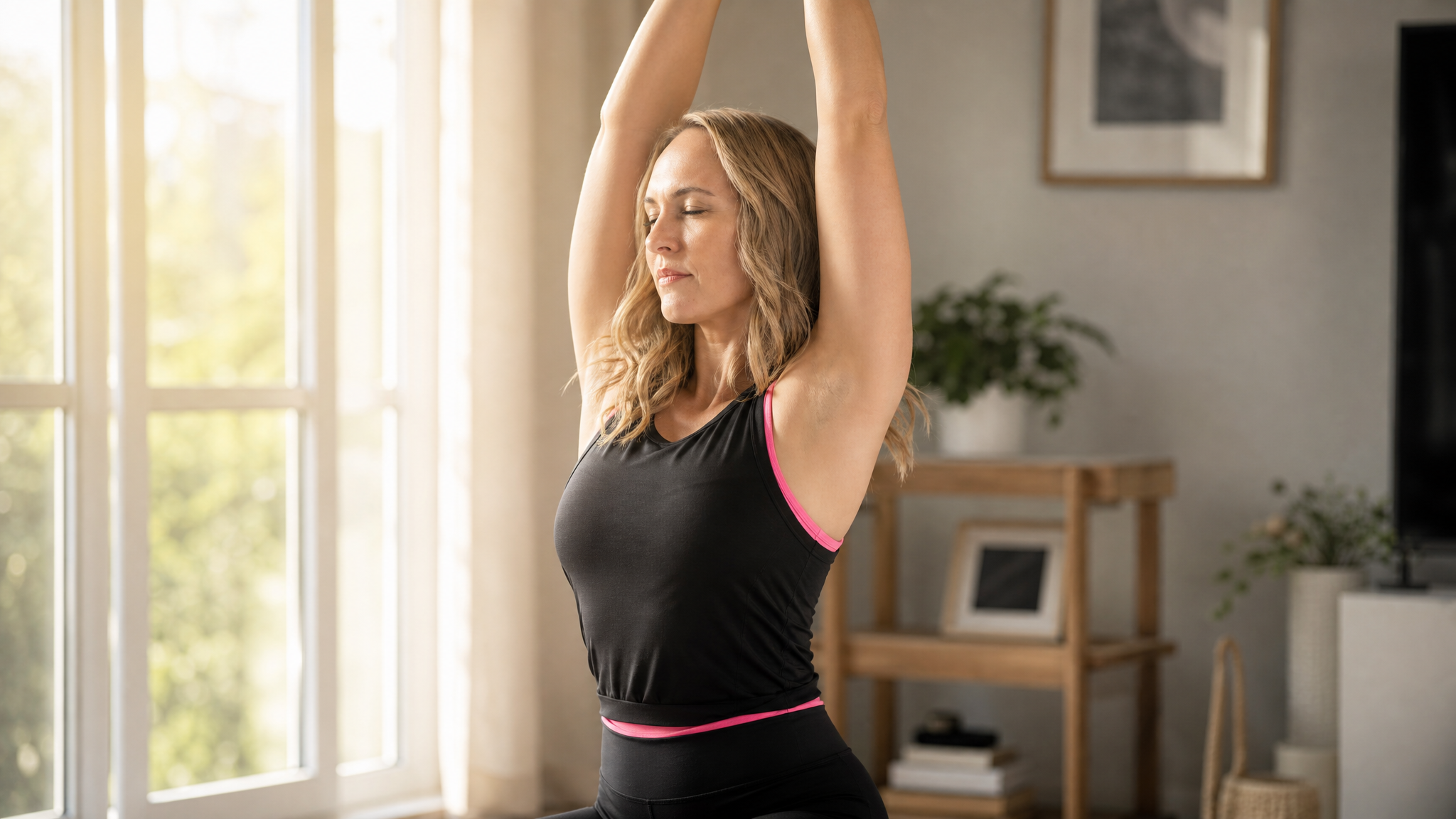
Stand with feet hip-width apart. Reach both arms overhead and interlace your fingers. Gently lean to the right, feeling a long stretch down your left side — from your fingertips through your ribs and into your hip. Hold for 30 seconds, breathing deeply, then switch to the left.
What it opens: The intercostal muscles between your ribs, the obliques, and the lats. This is why you can suddenly take a deeper breath after doing it — your ribcage literally has more room to expand.
2. Standing Forward Fold (45 seconds)
From standing, soften your knees and slowly fold forward from the hips, letting your head and arms hang heavy. Do not worry about touching your toes — just let gravity do the work. Nod your head yes and no a few times to release neck tension. Hold for 45 seconds.
What it opens: The entire posterior chain — hamstrings, lower back, calves and the muscles along your spine. The gentle head nod also releases the suboccipital muscles at the base of your skull, which get tight from looking at screens.
3. Cat-Cow (1 minute)
Come down to all fours with hands under shoulders and knees under hips. On an inhale, drop your belly towards the floor and lift your chest and tailbone (cow). On an exhale, round your spine towards the ceiling, tucking your chin and tailbone (cat). Flow between the two for about 1 minute — roughly 8–10 cycles.
What it opens: The entire spine, segment by segment. Cat-cow mobilises every vertebra, wakes up the spinal extensors and flexors, and gently engages the core. It is one of the best things you can do for a stiff back first thing in the morning.
4. Kneeling Hip Flexor Stretch (30 seconds each side)
From all fours, step your right foot forward into a lunge position, with your left knee on the ground (place a pillow under it if needed). Keep your torso upright and gently press your hips forward until you feel a stretch at the front of your left hip. Hold for 30 seconds, then switch sides.
What it opens: The hip flexors — specifically the psoas, which connects your spine to your legs. After a night of sleeping in a curled-up position, this muscle is almost always tight. Releasing it first thing can reduce lower back achiness for the entire day.
5. Chest Opener (45 seconds)
Stand in a doorway. Place your forearms on each side of the door frame at roughly shoulder height, elbows bent to 90 degrees. Step one foot gently through the doorway until you feel a stretch across your chest and the front of your shoulders. Hold for 45 seconds, breathing deeply.
What it opens: The pectorals and the anterior deltoids — the muscles that pull your shoulders forward into that rounded posture. If you wake up with tight shoulders or upper back tension, this single stretch can make a dramatic difference.
6. Neck Rolls (30 seconds)
Stand or sit tall. Slowly drop your right ear towards your right shoulder, then gently roll your chin down towards your chest and over to the left shoulder. Reverse direction. Do 3 slow rolls in each direction — about 30 seconds total. Keep the movement smooth and controlled.
What it opens: The upper trapezius, scalenes, levator scapulae and the small muscles at the base of the skull. These are the muscles responsible for that "carrying the weight of the world on your shoulders" feeling.
Tips to Make It Stick
- Do it before coffee. Attach it to your existing morning routine — alarm goes off, feet hit the floor, five minutes of stretching, then coffee. Habit stacking makes it automatic.
- Do it in your pyjamas. No need to change into activewear. Removing barriers makes you more likely to actually do it.
- Do not rush. Five minutes means five actual minutes, not a frantic 90-second speed-stretch. Set a timer if you need to.
- Breathe through every stretch. Slow exhales tell your nervous system it is safe to relax, which allows muscles to release more effectively.
- It is okay to modify. If getting on the floor is difficult, do the cat-cow standing with hands on a bench, and the hip flexor stretch standing with one foot on a step. The stretch still works.
What You Will Notice
Within the first week, most women notice they feel less stiff by mid-morning. Within two to three weeks, you will likely notice:
- Less lower back pain when you first get up
- Shoulders sitting lower and more relaxed
- Better posture without having to think about it
- More energy and alertness in the first hour of your day
- A calmer, more centred start to your morning (this one surprises people)
Five minutes is genuinely all it takes. Not an hour. Not thirty minutes. Five minutes of the right stretches, done consistently, will change how your body feels from the moment you wake up.
The Bottom Line
Your body was not designed to go from horizontal to full speed in sixty seconds. After 40, it needs a gentle transition — and this five-minute routine is exactly that. Think of it as a kindness to your future self: the version of you who walks into the kitchen feeling loose, tall and ready for the day instead of shuffling in like a creaky door.
Save this routine, try it tomorrow morning, and see how you feel. I think you will be surprised by what five minutes can do. 💛
Free 7-Day Beginner Strength Plan
Three simple full-body dumbbell workouts with form cues, warm-ups and rest days built in — designed for women over 40.
🔒 No spam, ever. Unsubscribe anytime.
Want personalised help with this?
My 1:1 online coaching gives you a fully custom training and nutrition plan built around your goals, your body, and your life. 12 weeks, $69/week, with me in your corner the whole way.
Learn About CoachingFree 7-Day Fat Loss Meal Plan
A printable week of protein-forward meals, shopping list, meal prep guide and tracker — designed for women over 40.