Back Exercises for Women Over 40: The Muscle Group You Never See (But Always Feel)
Ask most women over 40 which body part they train least, and the answer is almost always the same: their back. It is the one area you cannot see in the mirror, so it is the one area that quietly gets skipped — year after year, decade after decade. And then one day you catch a side-on photo of yourself, or you notice the way your bra strap sits, or your neck aches by 3pm every single afternoon, and you realise something has changed.
Here is what I want you to know: a weak back is not a character flaw and it is not permanent. Your back muscles are some of the most responsive, trainable muscles in your entire body — and strengthening them will do more for how you look, feel and move after 40 than almost anything else you could do in the gym.
Free 7-Day Beginner Strength Plan
Three simple full-body dumbbell workouts with form cues, warm-ups and rest days built in — designed for women over 40.
🔒 No spam, ever. Unsubscribe anytime.
Why Your Back Deserves Your Attention After 40
Your back is not one muscle. It is a whole network — the big fan-shaped lats down your sides, the rhomboids between your shoulder blades, the upper, middle and lower trapezius across your shoulders and neck, the rear deltoids, and the deep spinal erectors running the length of your spine. Together they hold you upright, they stabilise every single lift you do, and they are the reason you can carry, pull, reach and twist without pain.
After 40, several things stack up against them:
- Decades of forward living. Driving, desk work, phones, cooking, gardening, holding babies and then grandbabies — nearly everything we do happens in front of us. The muscles at the front shorten and tighten, the muscles at the back lengthen and switch off.
- Muscle loss accelerates. From around 40 we lose muscle mass each decade unless we actively train against it, and the postural muscles of the upper back are among the first to fade because they get so little demand placed on them.
- Falling oestrogen. Declining oestrogen affects connective tissue, joint comfort and muscle protein synthesis, which is part of why shoulders and upper backs start feeling stiff and cranky in your forties and fifties.
- Bone density. The thoracic spine is one of the most common sites for age-related bone loss and compression fractures. Strong back muscles and loaded pulling exercises help protect it.
What Changes When You Train Your Back
You stand taller — instantly and permanently
This is the one women notice first. When your rhomboids and mid-traps get strong enough to hold your shoulder blades where they belong, your chest opens, your shoulders drop back, and you gain what feels like an inch of height. Clothes hang better. Photos look different. Nothing about your weight has changed.
The "bra bulge" softens
Let us talk about it honestly, because so many women are quietly bothered by it. That roll around the bra line is partly skin and body fat, but a huge part of it is posture — rounded shoulders and a collapsed upper back push soft tissue forward and create a fold where there did not used to be one. Strengthening the upper back genuinely changes how that area sits, and it does it faster than fat loss does.
Neck and shoulder pain eases
When your mid-back is weak, your neck and upper traps do the work instead. They are not built for it, so they get tight, knotted and painful. Build strength lower down and that constant tension across the top of your shoulders often quietly disappears.
Every other lift gets stronger
Your back stabilises squats, deadlifts, presses and carries. Women who plateau on their other lifts are very often limited by a weak upper back, not weak legs or arms.
Lower back pain often improves
Counterintuitive but true. A strong, well-trained back is a resilient back. Most non-acute lower back discomfort in mid-life comes from weakness and deconditioning, not from fragility.
Six Back Exercises Every Woman Over 40 Should Master
You do not need a lat pulldown machine or a cable stack. A pair of dumbbells and a resistance band will cover everything that matters. Work through these in order — the first two are the foundation.
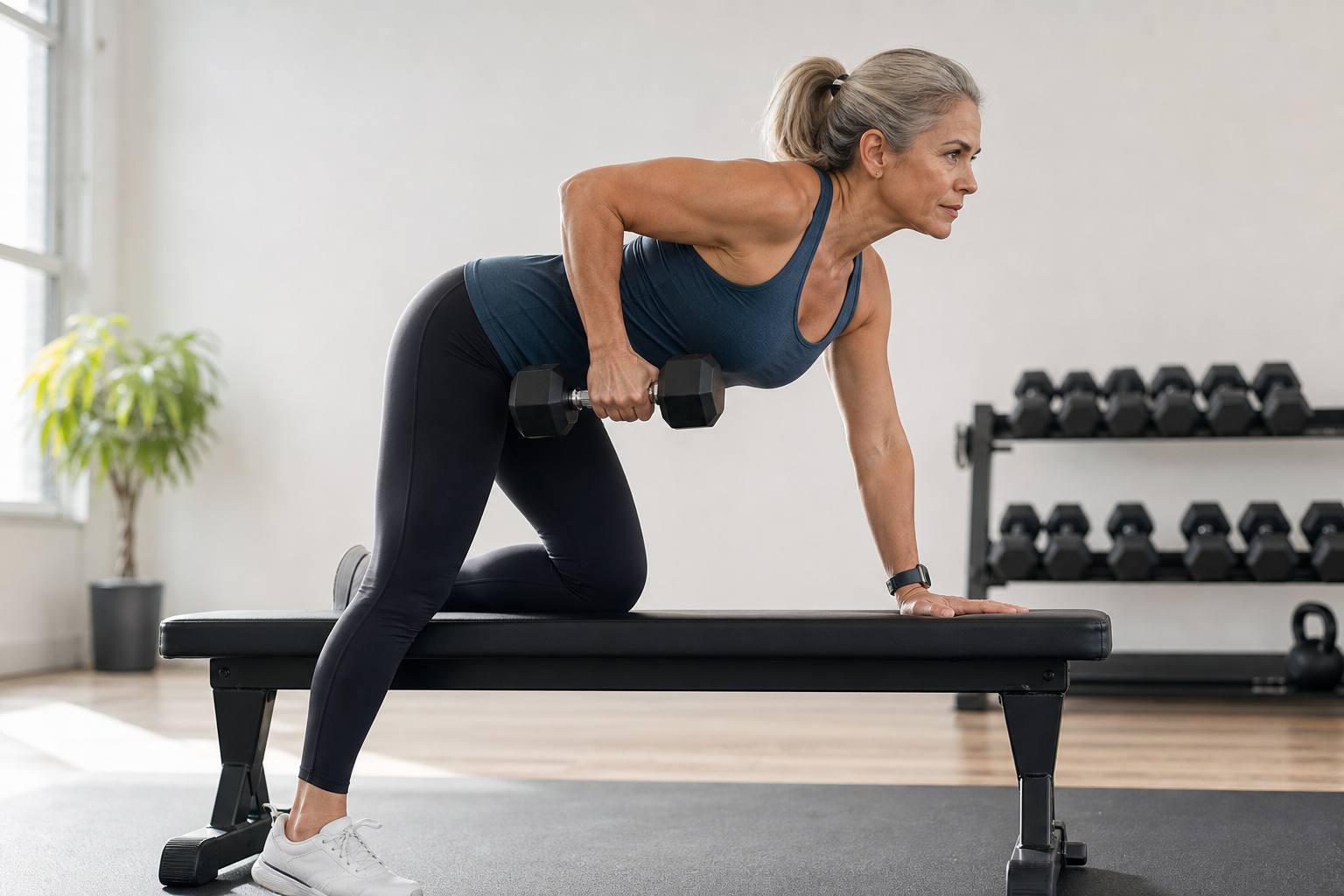
1. Single-Arm Dumbbell Row
The single best back exercise for women over 40, because it lets you go heavier safely while your braced arm supports your spine.
How to do it: Place your left hand and left knee on a bench (or your left hand on a chair seat), right foot on the floor, back flat and roughly parallel to the ground. Let the dumbbell hang from your right hand. Pull your elbow back and up toward your hip, driving your shoulder blade toward your spine. Pause for a beat at the top. Lower slowly under control.
Sets and reps: 3 sets of 8–10 each side.
Cue that changes everything: lead with your elbow, not your hand. Think about putting your shoulder blade in your back pocket.
2. Bent-Over Dumbbell Row (Both Arms)
Trains both sides at once and teaches you to hold a strong hip hinge — a skill that carries into deadlifts and real life.
How to do it: Stand with feet hip-width, dumbbells in hand. Push your hips back and hinge forward until your torso is around 45 degrees, keeping a small bend in your knees and a long, flat spine. Row both dumbbells toward your lower ribs, squeeze, then lower.
Sets and reps: 3 sets of 10.
Watch for: rounding your lower back or letting your neck crane up. Eyes down and slightly forward.
3. Band Pull-Apart
Small, humble, and the most underrated posture exercise there is. Perfect as a warm-up or to do while the kettle boils.
How to do it: Hold a light resistance band with both hands at shoulder height, arms straight in front of you. Pull the band apart until your arms are out wide, squeezing your shoulder blades together. Return slowly.
Sets and reps: 2–3 sets of 15–20.
Why it works: it targets the rear deltoids and rhomboids — precisely the muscles that switch off from desk work.
4. Prone Y-T-W Raises
No weight needed and brutally effective. This one wakes up the muscles that hold your shoulder blades in place.
How to do it: Lie face down on a mat, forehead resting on a folded towel. Lift your arms just off the floor and make a Y shape overhead, lower. Then a T out to the sides, lower. Then a W with elbows bent, lower. That is one round.
Sets and reps: 2–3 sets of 5 rounds.
Go light: bodyweight only at first. Tiny movements, big effect.
5. Lat Pulldown or Band Pulldown
Vertical pulling builds the width and shape of your back and keeps your shoulders healthy overhead.
How to do it: Anchor a band above a doorframe (or use a machine). Kneel or sit tall, pull the band down toward your collarbones, elbows driving down and back. Control the return.
Sets and reps: 3 sets of 10–12.
6. Dumbbell Romanian Deadlift
Trains the whole back line — glutes, hamstrings and spinal erectors — and teaches the hinge pattern that protects your lower back for life.
How to do it: Dumbbells in front of your thighs, knees softly bent. Push your hips back and slide the weights down your legs, keeping your spine long, until you feel a stretch in your hamstrings. Drive your hips forward to stand.
Sets and reps: 3 sets of 8–10.
A Simple Weekly Back Plan
You need less than you think. Two focused sessions a week will visibly change your posture within six to eight weeks.
- Session A — Single-arm row 3x8 each side, band pulldown 3x12, band pull-apart 3x15.
- Session B — Bent-over row 3x10, Romanian deadlift 3x8, prone Y-T-W 2x5 rounds.
- Daily bonus — one set of 15 band pull-aparts whenever you think of it.
Leave at least one day between sessions. Progress by adding a rep or two before you add weight, and only add weight when the last rep still looks as clean as the first.
The Mistakes I See Most Often
- Pulling with the arms. If you only feel it in your biceps, you are not using your back. Slow down and initiate the movement by squeezing your shoulder blade.
- Going too heavy too soon. Rowing a weight you cannot control means your lower back and neck take over. Lighter and cleaner beats heavier and sloppy every time.
- Rounding the spine. Set your ribcage down, brace your midsection gently, and keep a long neutral spine through every rep.
- Ignoring the small stuff. Pull-aparts and Y-T-Ws are not glamorous, but they are what fix posture. Do them.
- Training back once a fortnight. Consistency beats intensity. Two modest sessions every week for two months will beat one heroic session a month for a year.
What About Existing Pain?
Mild stiffness that eases as you warm up is normal and usually improves with training. But sharp pain, pain that travels down an arm or leg, pins and needles, or pain that wakes you at night deserves a proper assessment from a physio or GP before you load it. Strength work is remarkably safe, but it is not a substitute for a diagnosis.
Start This Week
Your back is the muscle group with the biggest gap between how little attention it gets and how much it gives back. Two sessions a week. Six movements. A pair of dumbbells and a band. Within a couple of months you will stand differently, your clothes will fit differently, your neck will thank you, and every other lift you do will feel stronger.
Pick two of the exercises above and do them today. Not perfectly — just do them. That is how this always starts.
Free 7-Day Beginner Strength Plan
Three simple full-body dumbbell workouts with form cues, warm-ups and rest days built in — designed for women over 40.
🔒 No spam, ever. Unsubscribe anytime.
Want personalised help with this?
My 1:1 online coaching gives you a fully custom training and nutrition plan built around your goals, your body, and your life. 12 weeks, $69/week, with me in your corner the whole way.
Learn About CoachingFree 7-Day Fat Loss Meal Plan
A printable week of protein-forward meals, shopping list, meal prep guide and tracker — designed for women over 40.