5 Reasons Every Woman Over 40 Should Do Calf Raises
Here is a question for you: when did you last think about your calves? Not in a "do these boots look good" way — in a "can I trust my ankles to hold me on uneven ground" way. If the answer is never, you are not alone. The calves are one of the most neglected muscle groups in women's training, and yet they quietly influence everything from your balance and posture to the density of the bones in your lower legs.
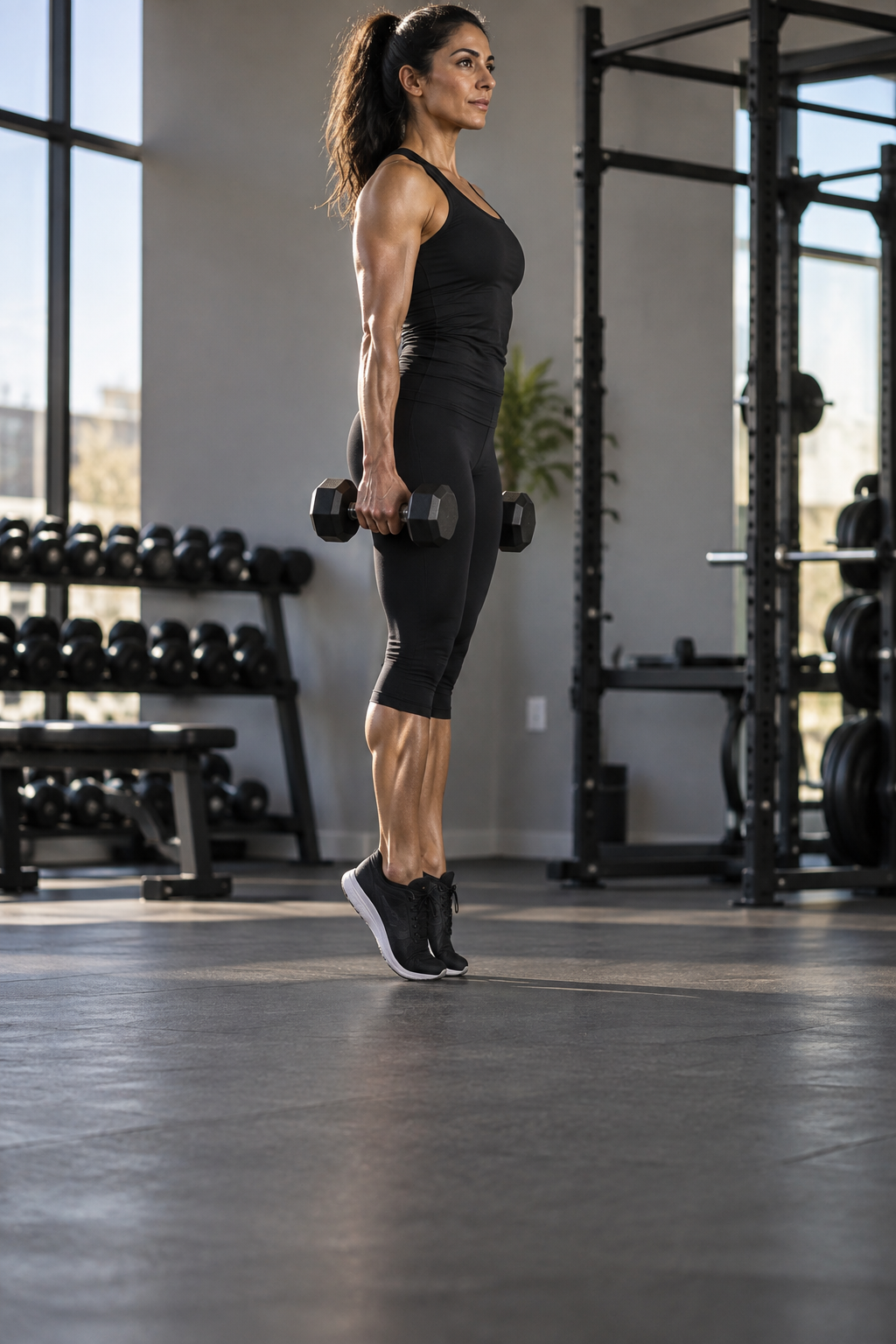
The standing calf raise is absurdly simple. You rise up onto the balls of your feet, hold for a beat, and lower back down. That is it. But do not let the simplicity fool you — this tiny movement delivers outsized benefits, especially for women navigating their 40s, 50s and beyond. Let me walk you through exactly why it deserves a permanent place in your routine.
Free 7-Day Beginner Strength Plan
Three simple full-body dumbbell workouts with form cues, warm-ups and rest days built in — designed for women over 40.
🔒 No spam, ever. Unsubscribe anytime.
What Does a Calf Raise Actually Work?
Your calf is made up of two key muscles. The gastrocnemius is the larger, more visible muscle that gives the back of your lower leg its shape. Sitting beneath it is the soleus, a deeper muscle that plays a huge role in endurance and posture — it is one of the muscles that keeps you upright when you stand for long periods.
When you perform a standing calf raise, both muscles contract to lift your heels off the ground. Your Achilles tendon — the thick band connecting your calf to your heel bone — also gets loaded and strengthened. And here is the part most people miss: your ankles, foot arches and the small stabilising muscles around your lower leg all have to work to keep you balanced at the top of the raise. It is a full lower-leg workout disguised as one simple movement.
5 Reasons Every Woman Over 40 Should Do Calf Raises
1. They Build Bone Density Where You Need It Most
After 40, and especially during and after menopause, declining oestrogen accelerates bone loss. The lower legs, ankles and feet are particularly vulnerable — and they are also the bones that take the most punishment when you walk, climb stairs or simply stand up from a chair. Loading these bones through calf raises sends a direct signal to your body to keep them strong. Research consistently shows that weight-bearing exercise targeting specific bones helps maintain and even improve their density. The standing calf raise is one of the most direct ways to load the bones of your lower legs without any impact or jarring.
2. Stronger Ankles Mean Fewer Falls and Rolled Ankles
Ankle sprains are not just a young athlete's problem. As we age, the ligaments and tendons around our ankles lose some of their elasticity, and the muscles that support them weaken from underuse. The result? A misstep off a kerb, a wobble on a gravel path, or a stumble on stairs becomes genuinely risky. Calf raises strengthen the muscles and tendons that surround and stabilise your ankle joint. Over time this creates a much more resilient, responsive ankle — one that can catch you before a wobble becomes a fall. For women over 40, this is not vanity training. It is injury prevention.
3. They Improve Balance You Can Feel Every Day
Balance is not something most of us think about until it starts to go. Standing on one foot to put on a shoe gets harder. Walking on a cobblestone street feels less secure. Getting up from the floor takes more effort. Your calves play a bigger role in balance than you might realise — they are part of the "ankle strategy" your nervous system uses to make constant micro-adjustments that keep you upright. When your calves are strong, these adjustments happen faster and more confidently. When they are weak, your body has to rely on bigger, clumsier corrections — or you simply lose your balance altogether.
4. They Sculpt and Tone Without Any Impact
If you have knee issues, hip pain or simply prefer low-impact training, the calf raise is a dream exercise. There is no jumping, no pounding and no awkward positions. You can do them standing on flat ground, on a step for extra range, holding dumbbells for added resistance, or even seated in a chair. They give your lower legs a sculpted, toned appearance while being completely gentle on your joints. And because the movement is so contained, you can easily add them to the end of any workout — or do a few sets while waiting for the kettle to boil.
5. They Take Two Minutes and Need Zero Equipment
This is the big one. You do not need a gym. You do not need dumbbells (though holding them makes the exercise harder as you progress). You do not need a special surface. You can do calf raises standing in your kitchen, in a hotel room, at the office, or waiting in line at the shops. Three sets of 15 repetitions takes roughly two minutes. There is genuinely no excuse not to do them — and those two minutes add up to meaningful strength and protection over weeks and months.
How to Do a Standing Calf Raise With Perfect Form
Step 1: Set your feet. Stand with your feet hip-width apart on flat ground. If you want extra range of motion, stand with the balls of your feet on the edge of a step and let your heels hang off the back.
Step 2: Rise up. Press through the balls of your feet and lift your heels as high as you can. Squeeze your calves hard at the top. Imagine you are trying to make yourself as tall as possible.
Step 3: Pause. Hold the top position for a full second. This is where the real work happens — do not rush through it.
Step 4: Lower slowly. Take two to three seconds to lower your heels back down. The slow lowering (eccentric) phase is where your muscles and tendons get the most benefit. If you are on a step, lower until you feel a gentle stretch in your calves.
Step 5: Repeat. Aim for three sets of 12 to 20 repetitions. Rest 30 to 60 seconds between sets.
Common Mistakes to Watch For
Rushing the reps. Bouncing up and down like a pogo stick robs you of the slow, controlled work that actually builds strength. Slow it down — two seconds up, one second hold, three seconds down.
Not going high enough. A half-hearted rise barely activates the calves. Push up until you are on your tip-toes and you feel a strong contraction. If you cannot get very high, that is fine — it will improve with practice.
Leaning forward. Keep your body upright and your weight centred over the balls of your feet. If you lean forward, you shift the work away from your calves. Hold onto a wall or chair for balance if you need to.
Ignoring the single-leg version. Once bodyweight double-leg raises feel easy, progress to single-leg calf raises rather than just adding speed. One leg at a time doubles the load and reveals (and fixes) any imbalances between your left and right side.
How to Progress Over Time
The calf raise is easy to scale. Start with bodyweight on flat ground. Move to a step edge for greater range of motion. Then hold dumbbells at your sides for extra resistance. Then try single-leg raises. Then single-leg raises on a step with a dumbbell. Each progression takes you further without needing any fancy equipment or a gym membership.
You can also vary the tempo — try a five-second lowering phase, or hold the top position for three seconds instead of one. Small changes to the timing create entirely different challenges for the same muscles.
The Bottom Line
The standing calf raise is proof that the best exercises are not always the flashiest. In two minutes a day with no equipment, you can build stronger bones, more resilient ankles, better balance and sculpted lower legs that carry you confidently through midlife and beyond. It is the kind of exercise you do because you are investing in a body that works brilliantly for the next 40 years — not just one that looks good in photos. Add it to your routine today. Your future self will thank you.
Free 7-Day Beginner Strength Plan
Three simple full-body dumbbell workouts with form cues, warm-ups and rest days built in — designed for women over 40.
🔒 No spam, ever. Unsubscribe anytime.
Want personalised help with this?
My 1:1 online coaching gives you a fully custom training and nutrition plan built around your goals, your body, and your life. 12 weeks, $69/week, with me in your corner the whole way.
Learn About CoachingFree 7-Day Fat Loss Meal Plan
A printable week of protein-forward meals, shopping list, meal prep guide and tracker — designed for women over 40.