The Dumbbell Chest Press: Build Real Upper-Body Strength After 40
When women think about upper-body strength, they often imagine it belongs to someone else — to men, to bodybuilders, to the young. I hear it all the time: "I don't want big arms, I just want to tone up." But here is the truth I wish every woman over 40 understood sooner. Building strength in your chest, shoulders and arms is not about bulking up. It is about being able to push open a heavy door, carry your shopping without straining, lift a suitcase into an overhead locker, and get up off the floor with ease. And the single best exercise to build that pushing strength is the dumbbell chest press.
It is one of the most satisfying, empowering movements you can learn — and it works beautifully with nothing more than a pair of dumbbells and a bench (or even the floor). Let me walk you through why it matters so much after 40 and exactly how to do it well.
Free 7-Day Beginner Strength Plan
Three simple full-body dumbbell workouts with form cues, warm-ups and rest days built in — designed for women over 40.
🔒 No spam, ever. Unsubscribe anytime.
Why Pushing Strength Matters After 40
Every day your body performs pushing movements. You push yourself up out of a chair or the bath. You push a heavy trolley, a stiff door, a lawnmower. You push up off the floor after playing with a grandchild or picking something up. These are all powered by the same muscles the chest press trains: your chest, the fronts of your shoulders, and your triceps at the back of your arms.
After 40, we lose muscle steadily unless we actively work to keep it — a process called sarcopenia. The muscles of the upper body are often the first to fade, simply because most of us rarely challenge them. When you train them deliberately, wonderful things happen:
- Everyday tasks become effortless. Carrying, lifting and pushing stop feeling like a strain.
- You protect your shoulders. Strong, balanced muscles around the shoulder joint keep it stable and far less prone to the aches and injuries that creep in with age.
- You build bone density. Loading your upper body against resistance signals your bones — including the vulnerable bones of the wrist and upper arm — to stay strong.
- You improve your posture. A strong, balanced upper body helps you stand tall rather than rounding forward.
- You feel genuinely capable. There is a particular kind of confidence that comes from pressing a weight up and knowing your body is getting stronger.
The Move: Dumbbell Chest Press
The dumbbell chest press is wonderfully straightforward, and dumbbells are actually kinder to your shoulders than a barbell because each arm moves freely and naturally. Here is how to do it step by step.
Setting Up
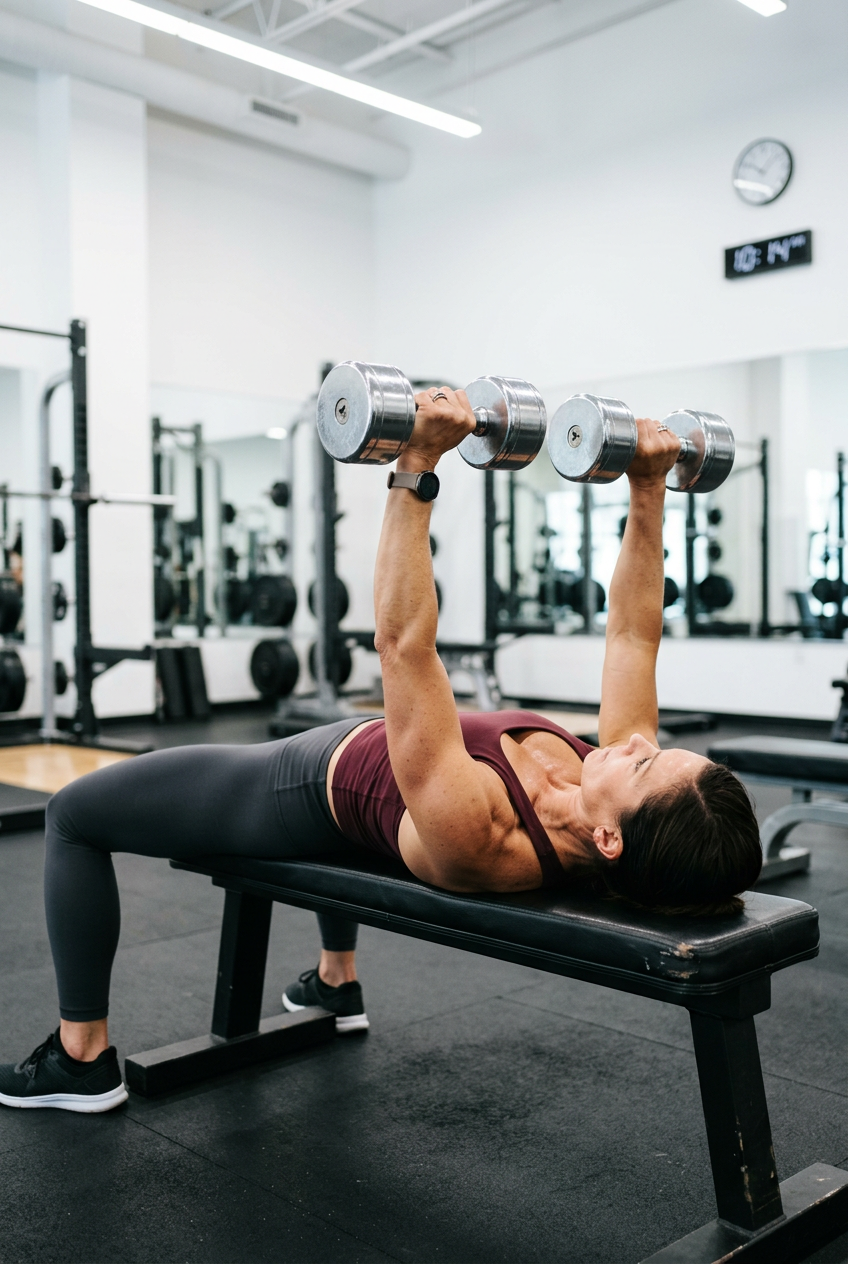
Lie back on a flat bench with a dumbbell in each hand. If you do not have a bench, lying on the floor works beautifully and even acts as a natural safety stop for your elbows. Plant your feet firmly, and start with the dumbbells held at chest height, elbows bent and pointing out at roughly a 45-degree angle from your body — not flared straight out to the sides.
The Press
Press the dumbbells up and slightly together until your arms are extended above your chest, without locking your elbows harshly. Keep your wrists stacked over your elbows throughout. Your shoulder blades should stay gently squeezed back and down against the bench — think of keeping your chest proud rather than letting your shoulders roll forward.
The Lower
Lower the dumbbells slowly and with control back to chest height, feeling a gentle stretch across your chest. The lowering phase is where a great deal of the strength is built, so resist the urge to let the weights drop quickly. Aim for 3 sets of 10 to 12 repetitions, resting for a minute between sets.
Common Mistakes to Avoid
- Flaring your elbows straight out. Elbows at 90 degrees to your body put unnecessary strain on the shoulder joint. Keep them at that friendlier 45-degree angle.
- Arching your lower back. Keep your ribs down and your back in a natural, neutral position against the bench. A big arch means the weight is too heavy.
- Rushing the lowering phase. Slow and controlled builds far more strength than fast and bouncy.
- Going too heavy too soon. Form always comes first. Start lighter than you think and progress as it feels easy.
How to Make It Easier or Harder
If a full chest press feels like too much at first, start on the floor with lighter dumbbells, which shortens the range of motion and keeps everything controlled. You can also begin with a very light weight or even no weight, simply grooving the movement pattern.
When you are ready to progress, the simplest route is to gradually increase the weight of your dumbbells. You can also slow the lowering phase to a count of three, or try a single-arm press which adds a lovely core stability challenge as your body resists rotating.
Fitting It Into Your Week
The chest press is your "push" movement, and it belongs in a balanced routine alongside a pull (like a row), a squat, a hinge (like a deadlift) and some core work. Train these fundamental movements twice a week and you cover everything your body needs to stay strong and functional. Two short, focused strength sessions a week is genuinely enough to transform how capable you feel.
Pair your chest press with a rowing movement in the same session to keep your shoulders balanced — pushing and pulling in equal measure keeps the shoulder joint healthy and your posture upright.
Your Strong Era Starts Here
There is something quietly powerful about pressing a weight up above you and feeling your own strength answer back. The dumbbell chest press proves that upper-body strength is not reserved for anyone else — it is yours to build, at any age, starting exactly where you are today.
Start light, focus on control, and be patient. Within a few weeks you will notice everyday pushing tasks feeling easier, your shoulders feeling more stable, and a new confidence in how your arms and upper body feel. This is what strong after 40 looks like — capable, confident and completely within your reach. You have got this. 💛
Free 7-Day Beginner Strength Plan
Three simple full-body dumbbell workouts with form cues, warm-ups and rest days built in — designed for women over 40.
🔒 No spam, ever. Unsubscribe anytime.
Want personalised help with this?
My 1:1 online coaching gives you a fully custom training and nutrition plan built around your goals, your body, and your life. 12 weeks, $69/week, with me in your corner the whole way.
Learn About CoachingFree 7-Day Fat Loss Meal Plan
A printable week of protein-forward meals, shopping list, meal prep guide and tracker — designed for women over 40.