The Dumbbell Thruster: One Move to Transform Your Total-Body Strength After 40
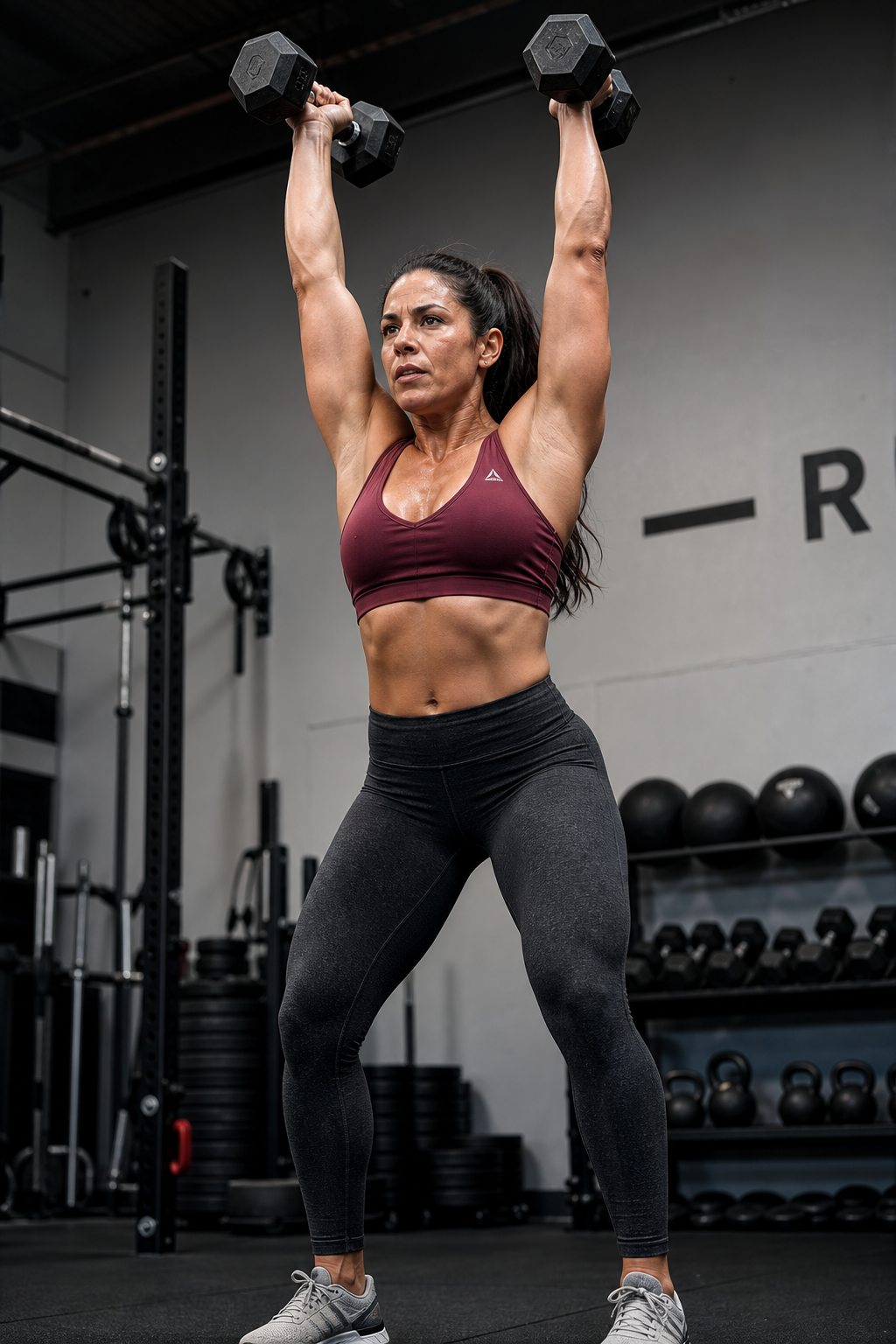
There is a moment during a dumbbell thruster when everything clicks. You are at the bottom of a squat, dumbbells at your shoulders, legs loaded — and then you drive. Your legs push the floor away, the power travels up through your core, and the dumbbells fly overhead as your whole body works as one. It is explosive, it is challenging, and it is one of the most effective exercises you can do after 40.
I know what you might be thinking. That sounds intense. Maybe too intense. But the dumbbell thruster is one of those brilliant exercises that scales beautifully — from a gentle bodyweight version all the way to a serious strength-and-conditioning challenge. No matter where you start, it delivers extraordinary results for the time you invest.
Free 7-Day Beginner Strength Plan
Three simple full-body dumbbell workouts with form cues, warm-ups and rest days built in — designed for women over 40.
🔒 No spam, ever. Unsubscribe anytime.
What Is a Dumbbell Thruster?
A thruster is a combination of two fundamental movements: a front squat and an overhead press, performed as one continuous motion. You hold two dumbbells at shoulder height, squat down until your thighs are at least parallel with the floor, then drive up explosively and use that momentum to press the dumbbells overhead. Lower the weights back to your shoulders, descend into the next squat, and repeat.
It is fluid, rhythmic and, when performed well, genuinely beautiful to watch. But more importantly, it is one of the most metabolically demanding exercises you can do — meaning it burns serious calories while building serious strength.
Why It Is Perfect for Women Over 40
Here is the reality of training after 40: we have less time, our recovery needs are higher, and we need our training to be as efficient as possible. The thruster answers all of these demands.
Total-body strength in one move. Your quads, glutes, hamstrings, core, shoulders, triceps and upper back are all working hard during every single rep. Instead of doing a separate squat exercise and a separate shoulder press — which takes twice the time and twice the sets — the thruster combines them into one powerful movement.
Cardiovascular conditioning without impact. This is a big one for women over 40. Running and jumping can be hard on the joints, especially the knees and pelvic floor. The thruster elevates your heart rate significantly — to the point where you will be breathing hard after just eight or ten reps — without any impact whatsoever. It is conditioning that respects your body.
Functional movement patterns. Think about how many times a day you squat down and reach up. Putting something on a high shelf. Lifting a bag of compost into the garden bed. Picking up a toddler and swinging them overhead. The thruster trains exactly this pattern — heavy things going from low to high — making everyday life feel easier and safer.
Metabolic fire. Because the thruster uses so much muscle mass at once, it creates a massive metabolic demand. Your body has to work harder to fuel all those muscles, which means more calories burned during the workout and an elevated metabolic rate for hours afterwards. For women dealing with the metabolic slowdown that comes with perimenopause and menopause, this is incredibly valuable.
Bone-loading in multiple directions. Your lower body is loaded through the squat, your spine is loaded vertically, and your shoulders and arms are loaded through the press. This multi-directional loading is exactly what bones need to stay dense and strong — particularly important for women as oestrogen levels decline.
How to Do It With Proper Form
Stand with your feet shoulder-width apart or slightly wider, toes turned out about 15 degrees. Hold a dumbbell in each hand at shoulder height, palms facing each other, elbows pointing slightly forward. This is your starting position.
Take a breath, brace your core, and sit back and down into a squat. Keep your chest proud and your weight in your heels and midfoot. Descend until your thighs are at least parallel with the floor — deeper if your mobility allows.
Now the magic happens. Drive hard through your feet, straighten your legs explosively, and use that upward momentum to press the dumbbells overhead. Your arms should finish fully extended, biceps by your ears. The power comes from your legs, not your shoulders — the press is just the follow-through.
Lower the dumbbells back to your shoulders as you simultaneously begin your descent into the next squat. The movement should be fluid and continuous — down, up, press, lower, down, up, press, lower.
Key technique points:
Drive from the legs. The most common mistake is trying to muscle the dumbbells overhead with your arms. The press should feel almost effortless because your legs are doing the hard work. Think of your legs as the engine and your arms as the steering wheel.
Stay upright. If you find yourself tipping forward at the bottom of the squat, the weight might be too heavy or your ankle mobility might need work. A small heel elevation — standing on thin weight plates — can help while you build flexibility.
Breathe with purpose. Inhale on the way down, exhale explosively as you drive up and press. The exhale should be forceful — it helps generate power and protects your core.
Lock it out overhead. Finish each rep with the dumbbells fully overhead, arms straight, core braced. A half-hearted press that stops short of full extension cheats your shoulders of the full range of motion and the strength benefits that come with it.
How to Scale It
If the full dumbbell thruster feels like too much right now, here is how to build towards it progressively:
Bodyweight squat to reach. Perform a bodyweight squat, then as you stand, reach both arms overhead. This grooves the movement pattern without any load. Do this for two to three weeks until the timing feels natural.
Goblet thruster. Hold a single dumbbell at your chest with both hands (goblet position). Squat down, drive up, and press the dumbbell overhead. This is lighter and easier to control than two separate dumbbells.
Paused thruster. Add a two-second pause at the bottom of the squat and another at the top of the press. This breaks the movement into pieces and lets you focus on position rather than momentum. Excellent for building confidence.
Squat and press separately. If the combination feels overwhelming, do five front squats, rest briefly, then five overhead presses. Once both feel comfortable individually, start linking them together.
Programming It Into Your Training
The thruster is versatile enough to fit into almost any session structure:
As a warm-up finisher: 2 sets of 8 reps with very light dumbbells (2–4 kg) after your general warm-up. This primes your whole body for the session ahead.
In a strength circuit: 3–4 sets of 8–10 reps with moderate weight (5–10 kg). Pair with a pulling exercise like a bent-over row for a balanced superset. Rest 90 seconds between rounds.
As a metabolic finisher: Set a timer for 60 seconds and perform as many quality reps as you can. Rest 60 seconds, repeat for 3–4 rounds. This will get your heart pumping and your metabolism firing.
In a full-body session: Programme it as your first compound movement of the day when you are freshest. Follow with accessory work — lunges, rows, core work — to round out the session.
Common Mistakes to Watch For
Squatting too shallow. A quarter-squat thruster is a quarter of the benefit. Get your thighs to at least parallel. This is where the glutes and hamstrings switch on properly, and it is where the real power for the press comes from.
Pressing too early. The press should happen at the top of the squat, driven by leg momentum. If you start pressing while you are still in the squat, you lose the power transfer and turn it into a slow, grinding shoulder press. Time it so the dumbbells leave your shoulders just as your legs reach full extension.
Collapsing the chest. As fatigue sets in, your upper back will want to round and your chest will drop. Fight it. A proud chest means a safe spine. If you cannot maintain position, the set is done.
Holding your breath. The thruster demands oxygen. Holding your breath will make you dizzy and limit your reps. Breathe rhythmically — in on the descent, out on the drive and press.
Why This Move Transforms Your Training
I have coached hundreds of women through their forties, fifties and beyond, and the dumbbell thruster is one of the exercises that changes things most visibly. Not just in how their bodies look — although the combination of leg and shoulder development is undeniably flattering — but in how they feel. Capable. Explosive. Strong in a way that shows up everywhere.
It is the exercise that makes carrying the shopping feel effortless. The one that means you can lift a suitcase into the overhead locker without asking for help. The one that gives you the cardiovascular fitness to run for a bus without feeling like you might collapse.
Start light, learn the rhythm, and give yourself permission to find it hard at first. Within a few weeks, you will wonder how you ever trained without it. Your strong era is waiting — and this move will help you claim it.
Free 7-Day Beginner Strength Plan
Three simple full-body dumbbell workouts with form cues, warm-ups and rest days built in — designed for women over 40.
🔒 No spam, ever. Unsubscribe anytime.
Want personalised help with this?
My 1:1 online coaching gives you a fully custom training and nutrition plan built around your goals, your body, and your life. 12 weeks, $69/week, with me in your corner the whole way.
Learn About CoachingFree 7-Day Fat Loss Meal Plan
A printable week of protein-forward meals, shopping list, meal prep guide and tracker — designed for women over 40.