Hip Mobility Exercises for Women Over 40: Unlock Tight Hips in 15 Minutes a Day
If getting up from a chair feels stiff, crossing your legs has become uncomfortable, or your hips just feel "locked" most of the day — you are not imagining it. Tight hips are one of the most common issues women face after 40, and the good news is they respond beautifully to the right kind of movement.
Your hips are the largest ball-and-socket joints in your body. They are designed to move in every direction — flexion, extension, rotation, abduction. But modern life (hello, sitting for eight hours a day) trains them to do almost none of that. The muscles around the joint shorten, stiffen and forget how to move freely. Add hormonal changes that affect connective tissue elasticity after 40, and it is no wonder your hips feel like they belong to someone twenty years older.
The exercises below are gentle, effective and designed to be done at home in about 15 minutes. No gym, no equipment, no pretzel-shaped yoga poses. Just simple movements that open, strengthen and restore your hips — so you can move through your day with ease.
Free 7-Day Beginner Strength Plan
Three simple full-body dumbbell workouts with form cues, warm-ups and rest days built in — designed for women over 40.
🔒 No spam, ever. Unsubscribe anytime.
Why Hip Mobility Matters More After 40
Your hips are the bridge between your upper and lower body. When they are tight or restricted, everything else compensates — your lower back takes extra load, your knees track poorly, your posture rounds forward, and even your walking stride shortens. Many women who come to me with back pain, knee niggles or poor balance actually have a hip mobility problem underneath it all.
After 40, oestrogen decline also affects the synovial fluid that lubricates the joint, making it feel stiffer first thing in the morning or after sitting. Regular mobility work keeps that fluid moving and the joint surfaces healthy.
The best part? Hip mobility improves quickly. Most women notice a difference within two to three weeks of consistent practice.
6 Hip Mobility Exercises You Can Do at Home
1. 90/90 Hip Switch
Sit on the floor with both knees bent at roughly 90 degrees — one leg in front, one behind. Your front shin should be roughly parallel to your chest, your back shin parallel to your side. Sit tall, then slowly rotate both legs to switch sides, keeping your back straight. Move gently — no forcing. Do 8 switches total (4 each side).
Why it works: This is one of the best exercises for internal and external hip rotation — the two movements most people lose first. It teaches the hip to rotate freely without compensating through the lower back.
2. Kneeling Hip Flexor Stretch
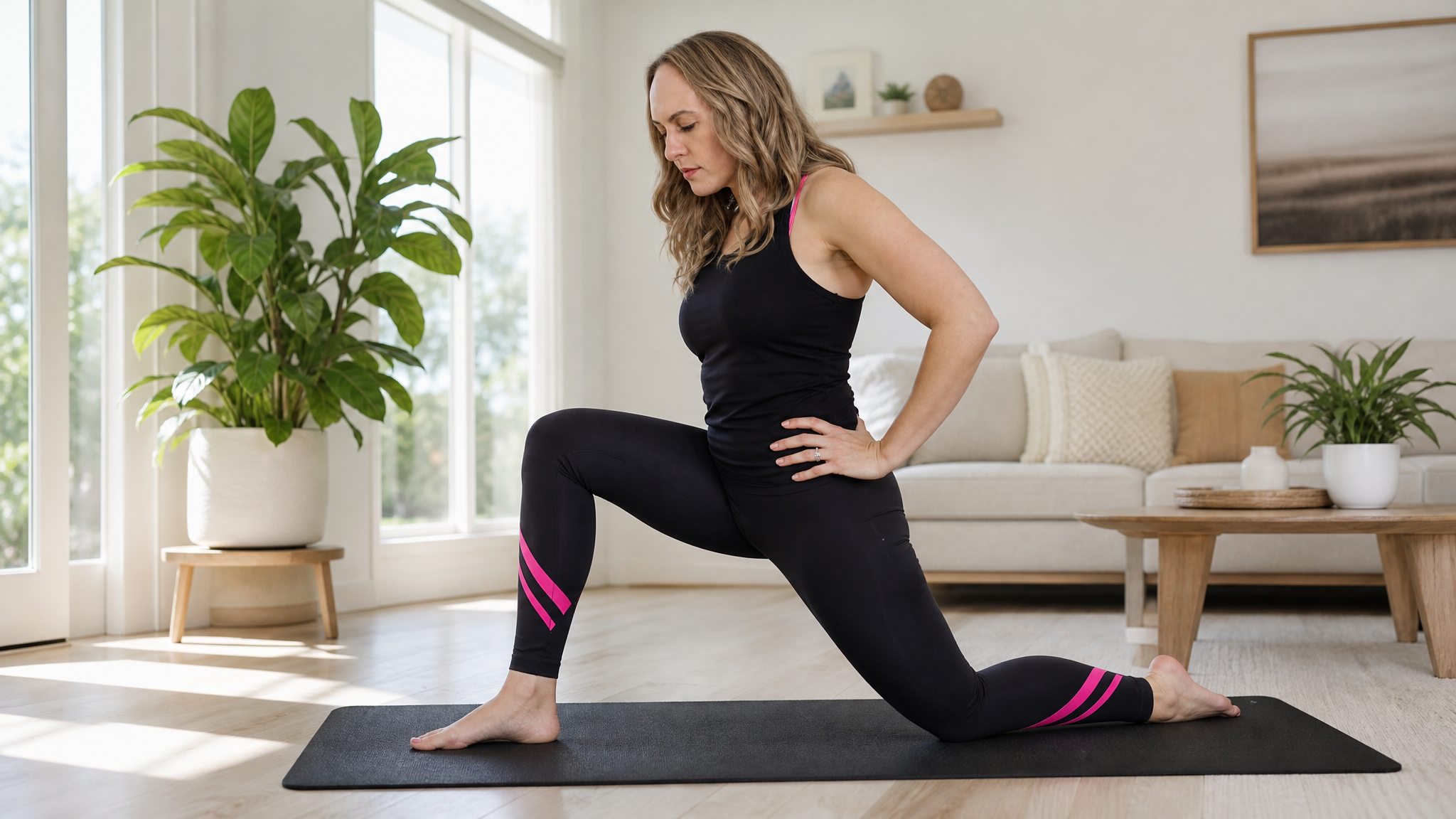
Kneel on one knee (place a cushion under it if needed) with the other foot flat on the floor in front. Gently shift your weight forward, keeping your torso upright and your core lightly engaged. You should feel a stretch at the front of the hip on the kneeling side. Hold for 30 seconds, then switch. Repeat twice each side.
Why it works: The hip flexors (psoas and iliacus) become chronically shortened from sitting. This stretch directly targets that tightness — and when your hip flexors release, your lower back often feels immediately better too.
3. Supine Figure-4 Stretch
Lie on your back with both knees bent. Cross your right ankle over your left knee, creating a figure-4 shape. Gently pull your left thigh towards your chest until you feel a deep stretch in your right hip and glute. Hold for 30 seconds, then switch sides.
Why it works: This targets the piriformis and deep external rotators — the muscles that get tight from sitting and can even contribute to sciatic-type pain down the leg. A must-do for anyone with desk-bound hips.
4. Hip Circles (Standing)
Stand on one leg, holding a wall or chair for balance. Lift the other knee to hip height, then slowly draw large circles with your knee — forward, out to the side, behind you and back. Do 5 circles in each direction, then switch legs.
Why it works: Hip circles move the joint through its full range of motion in a dynamic way. They warm up the joint capsule, activate the stabiliser muscles and improve proprioception (your body's sense of where it is in space).
5. Deep Squat Hold (Supported)
Stand with feet slightly wider than hip-width, toes turned out about 30 degrees. Slowly lower into a deep squat, holding onto a doorframe, sturdy table or the back of a heavy chair for support. Let your hips sink as low as is comfortable and hold for 20–30 seconds. If your heels lift, place a rolled towel underneath them.
Why it works: The deep squat is a position our bodies are designed for but rarely use. It opens the hips, stretches the inner thighs and decompresses the lower spine. Using support makes it accessible even if your mobility is limited right now.
6. Seated Butterfly Stretch
Sit on the floor with the soles of your feet together and your knees dropped open to the sides. Hold your feet with your hands and sit as tall as you can. Gently press your knees towards the floor using your elbows. Hold for 30 seconds, relax, and repeat 3 times.
Why it works: The butterfly opens the inner thighs (adductors) and the front of the hip. It is simple, soothing and one of those stretches you can do while watching television — which makes it much easier to stay consistent.
How to Build a Hip Mobility Habit
You do not need to do all six exercises every day. Pick 3 or 4 and rotate through them. Aim for 10–15 minutes, 4–5 times a week — first thing in the morning is ideal, because your hips are typically at their stiffest after sleep.
Here is a simple weekly pattern:
- Monday / Wednesday / Friday: 90/90 switches, hip flexor stretch, figure-4 stretch
- Tuesday / Thursday: Hip circles, deep squat hold, butterfly stretch
- Weekends: Pick your favourites or do a gentle walk instead
Consistency is everything here. Ten minutes a day will do more for your hips than an hour-long stretch session once a month.
Common Mistakes to Avoid
- Forcing the stretch. If it hurts, you have gone too far. A gentle pull or mild discomfort is fine; sharp pain is not. Back off and let your body open at its own pace.
- Holding your breath. Breathe slowly and deeply throughout each stretch. Your muscles release more when you exhale — try breathing out as you ease deeper into the position.
- Skipping the warm-up. A quick 1–2 minute walk on the spot before you start makes a noticeable difference. Cold muscles and joints do not stretch as well.
- Only stretching, never strengthening. Flexibility without strength is instability. Exercises like the 90/90 switch, hip circles and deep squat hold build both mobility AND control, which is why they are included here.
When to See a Professional
If your hip pain is sharp, one-sided, or accompanied by clicking, catching or giving way, please see your GP or a physiotherapist before starting a mobility routine. Conditions like hip bursitis, labral tears or early arthritis need a tailored approach — and a good physio can give you a version of these exercises that works safely for your situation.
The Bottom Line
Tight hips are not a life sentence — they are a signal that your body needs more varied movement. A simple 10–15 minute daily routine can restore range of motion, reduce back and knee pain, improve your posture and make everyday activities (bending, walking, getting up from the floor) feel easy again.
Save this list, pick three exercises to start with this week, and notice how quickly things change. Your hips were designed to move — let them. 💛
Free 7-Day Beginner Strength Plan
Three simple full-body dumbbell workouts with form cues, warm-ups and rest days built in — designed for women over 40.
🔒 No spam, ever. Unsubscribe anytime.
Want personalised help with this?
My 1:1 online coaching gives you a fully custom training and nutrition plan built around your goals, your body, and your life. 12 weeks, $69/week, with me in your corner the whole way.
Learn About CoachingFree 7-Day Fat Loss Meal Plan
A printable week of protein-forward meals, shopping list, meal prep guide and tracker — designed for women over 40.