
Knee-Strengthening Exercises for Women Over 40: Rebuild Confidence in Every Step
If your knees creak when you climb stairs, ache after a walk, or just feel unreliable, you are definitely not alone. Knee discomfort is one of the most common complaints women have after 40 — and it is also one of the most fixable.
Here is the thing most people get wrong: they rest their knees and avoid movement altogether. But weak muscles around the knee are usually the real problem. When your quads, hamstrings, glutes and calves are strong and balanced, they act like a protective brace — absorbing shock, stabilising the joint and taking pressure off the cartilage.
The exercises below are gentle, physiotherapist-approved and designed specifically for women over 40 who want stronger, more confident knees without the fear of making things worse.
Free 7-Day Beginner Strength Plan
Three simple full-body dumbbell workouts with form cues, warm-ups and rest days built in — designed for women over 40.
🔒 No spam, ever. Unsubscribe anytime.
Why Your Knees Need Strength, Not Just Rest
After 40, oestrogen levels begin to drop — and oestrogen plays a role in keeping cartilage healthy and inflammation low. That means the cushioning inside your knee joint can thin, and the ligaments around it can become a little less elastic.
At the same time, if you have been less active or sitting more than you used to, the muscles that support the knee lose strength. The joint ends up doing work that the muscles should be handling, which leads to pain, stiffness and that unsettling "giving way" feeling.
The solution is not to wrap your knees in cotton wool. It is to rebuild the muscular support system around them — gently, consistently and with good form.
Before You Start: A Few Ground Rules
- No pain is the goal. A gentle stretch or mild muscle fatigue is fine, but sharp or stabbing knee pain means stop. Adjust the range of motion or skip that exercise.
- Warm up first. A two-minute walk on the spot or gentle marching gets blood flowing to the joint before you load it.
- Go slow. These exercises work best with slow, controlled movement — not speed.
- Use a chair or wall for balance whenever you need it. There is no prize for wobbling.
6 Gentle Knee-Strengthening Exercises
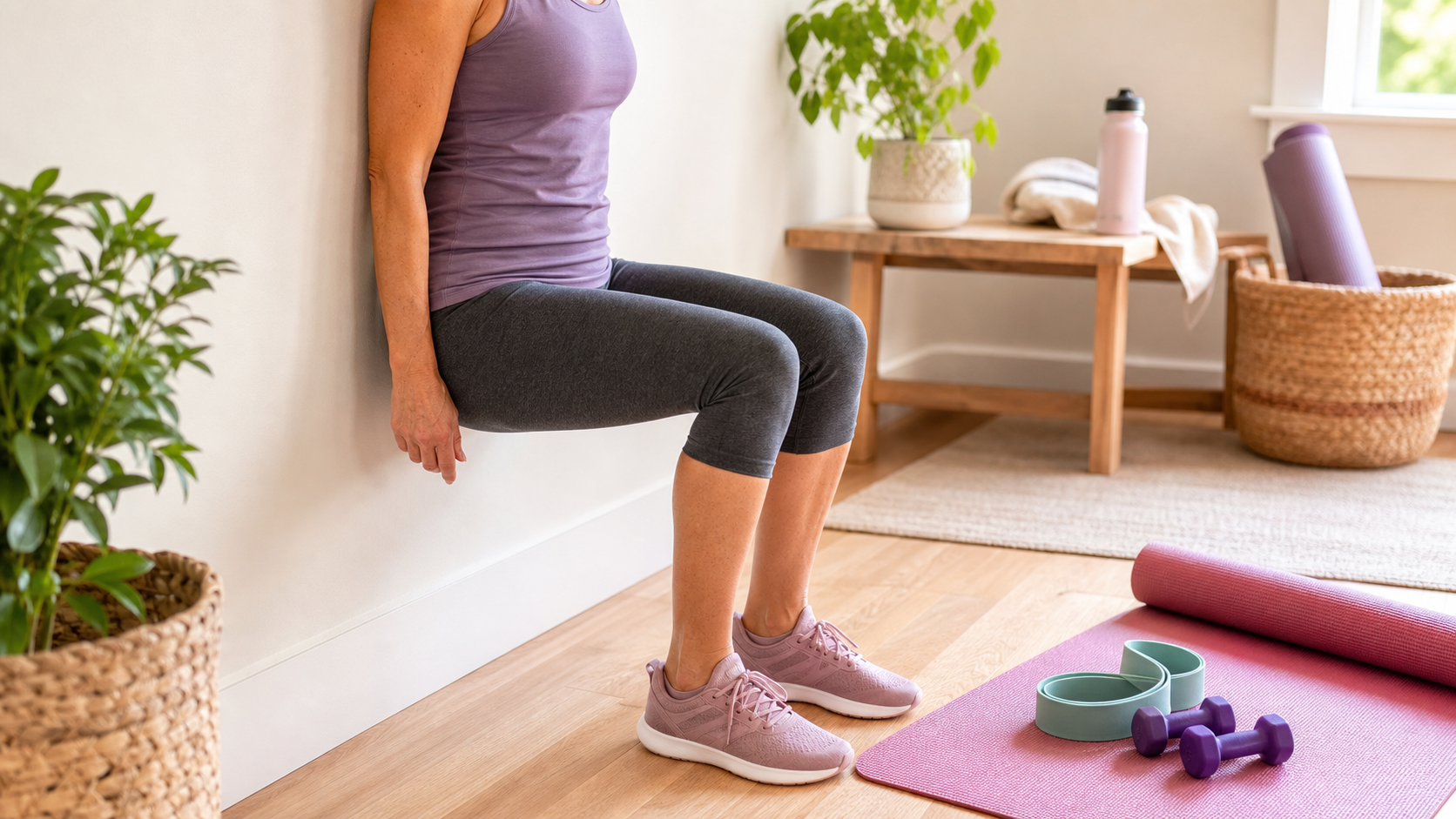
1. Wall Sit (Quad Strengthener)
Stand with your back flat against a wall. Slide down until your thighs are at roughly a 45-degree angle (not a full 90 — keep it gentle). Hold for 10–20 seconds, then stand back up. Rest and repeat 3–5 times.
Why it works: Wall sits strengthen the quadriceps — the big muscle group at the front of your thigh — without putting your knee through a large range of motion. Strong quads are the single biggest protector of the knee joint.
2. Straight Leg Raise (Lying Down)
Lie on your back with one knee bent (foot flat on the floor) and the other leg straight. Tighten the thigh muscle of the straight leg and slowly lift it about 30 centimetres off the ground. Hold for 3 seconds, then lower with control. Do 10 reps on each side.
Why it works: This strengthens the quads without bending the knee at all — perfect if your knee is currently cranky or recovering from a flare-up.
3. Glute Bridge
Lie on your back with both knees bent, feet flat on the floor, hip-width apart. Press through your heels and lift your hips towards the ceiling, squeezing your glutes at the top. Hold for 2–3 seconds, then lower slowly. Repeat 10–12 times.
Why it works: Weak glutes are a hidden cause of knee pain. When your glutes do not fire properly, your knee collapses inward during walking and stairs. Bridges wake up those glute muscles and teach them to share the load.
4. Step-Up (Low Step)
Stand in front of a low step — the bottom stair or a sturdy platform about 15–20 centimetres high. Step up with your right foot, pressing through the heel, then bring the left foot up to meet it. Step back down, leading with the left foot. Do 8–10 reps on each side.
Why it works: Step-ups mimic real life (stairs, curbs, getting in and out of cars) and strengthen your quads, hamstrings and glutes together. Start low — you can increase the height over time as you get stronger.
5. Calf Raise (Standing)
Stand behind a chair, holding the back for balance. Rise up onto the balls of your feet, lifting your heels as high as you can. Hold for 2 seconds at the top, then lower slowly. Repeat 12–15 times.
Why it works: Your calves help stabilise the ankle and the lower part of the knee joint. Strong calves reduce the jarring impact that travels up through the knee when you walk, especially downhill or on hard surfaces.
6. Seated Knee Extension
Sit on a chair with your feet flat on the floor. Slowly straighten one leg out in front of you until it is parallel to the ground (or as far as comfortable). Hold for 3 seconds, then lower with control. Do 10 reps on each side.
Why it works: This isolates the quadriceps through a safe, controlled range of motion. If you find it easy, try pausing at the top for 5 seconds, or loop a light resistance band around your ankle for extra challenge.
How Often Should You Do These?
Aim for 3 times a week, with at least one rest day between sessions. You do not need to do all six exercises every time — pick 3 or 4 and rotate. The entire routine takes about 10–15 minutes, and you can do it in your lounge room with no equipment at all.
Consistency matters far more than intensity here. Doing a gentle 10-minute knee routine three times a week will do more for your knees over six months than one brutal gym session ever could.
What About Walking and Cardio?
Walking is wonderful for knee health — as long as it is comfortable. If your knees ache during or after a walk, try shorter distances, flatter terrain, or slower pace and build up gradually. Swimming and cycling are also excellent low-impact options that strengthen the muscles around the knee without the jarring impact of running or jumping.
The key is to stay moving. Motion is lotion for joints — the more you move (within comfort), the more synovial fluid bathes the cartilage, keeping it nourished and supple.
When to See a Professional
These exercises are safe for most women, but please check with your GP or physiotherapist if you have:
- Significant knee swelling that does not settle
- Locking or catching of the joint
- Pain that wakes you at night
- A history of knee surgery or ligament injury
A good physio can assess your specific situation and tailor a program for you. Strengthening is almost always part of the plan — you will just get a version that fits your starting point.
The Bottom Line
Dodgy knees do not mean your active days are behind you. In most cases, they mean your muscles need some attention — and that is completely within your control. Start with the gentlest exercises on this list, do them consistently, and you will likely notice a difference within a few weeks: less stiffness, more confidence on stairs, and a knee that feels like it actually belongs to you again.
Save this list, start with just two or three exercises this week, and build from there. Your knees will thank you — and so will the future version of you who is still walking, hiking and dancing with confidence. 💛
Free 7-Day Beginner Strength Plan
Three simple full-body dumbbell workouts with form cues, warm-ups and rest days built in — designed for women over 40.
🔒 No spam, ever. Unsubscribe anytime.
Want personalised help with this?
My 1:1 online coaching gives you a fully custom training and nutrition plan built around your goals, your body, and your life. 12 weeks, $69/week, with me in your corner the whole way.
Learn About CoachingFree 7-Day Fat Loss Meal Plan
A printable week of protein-forward meals, shopping list, meal prep guide and tracker — designed for women over 40.