The Renegade Row: The One Move That Does It All After 40
If someone told you there was a single exercise that trained your back, your arms, your shoulders and your core all at once — without a single rep of crunches — you would probably think they were overselling it. But the renegade row is genuinely that good. It is one of the most efficient, time-saving exercises you can add to your training, and for women over 40 it has some special advantages that make it worth mastering.
I get it — it looks intimidating. A plank and a row combined? But here is the truth: once you understand the technique and scale it to your level, the renegade row is accessible, satisfying and one of the most empowering movements you will ever learn. Let me show you why it belongs in your programme, how to do it properly, and how to build up to it even if you are starting from scratch.
Free 7-Day Beginner Strength Plan
Three simple full-body dumbbell workouts with form cues, warm-ups and rest days built in — designed for women over 40.
🔒 No spam, ever. Unsubscribe anytime.
What Exactly Is a Renegade Row?
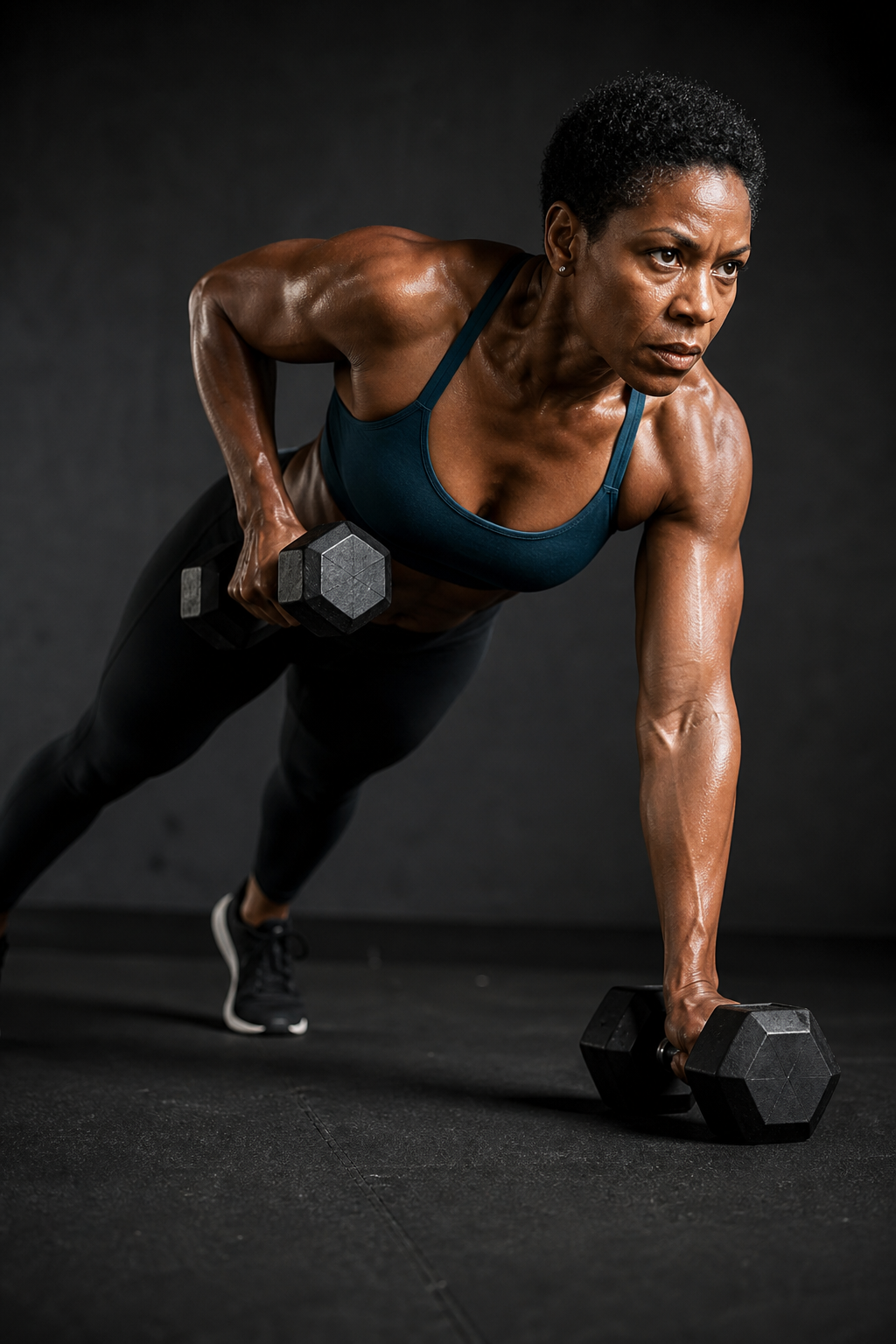
Picture a high plank — hands on dumbbells, feet wide, body in a straight line from head to heels. From that position, you row one dumbbell up towards your ribcage while the other arm stays locked, supporting your weight. Then you switch sides. That is one rep. It looks simple on paper, but every muscle in your body is working to keep you stable while you pull.
The beauty of it is the anti-rotation demand. Your core has to fight the urge to twist and collapse every time you lift a weight off the floor. That kind of core training — resisting movement rather than creating it — is far more functional and far more protective of your back than any sit-up could ever be.
Why Women Over 40 Should Be Doing This
As we move through our forties and beyond, we do not just lose muscle — we lose the coordination between muscles. Our core stops firing as efficiently. Our balance gets a little less reliable. The movements we used to do without thinking start to require more conscious effort. The renegade row addresses all of this in one go.
Here is what it trains:
Core stability. Not the flashy, six-pack kind. The deep, functional kind that protects your lower back when you pick up shopping bags, twist to check your blind spot while driving, or catch yourself when you stumble. This is the core strength that actually matters in everyday life.
Upper-back and lat strength. The pulling muscles of your back are some of the most neglected in the female body. We sit, we drive, we hunch over screens — and our backs get weaker and weaker. The renegade row directly targets your lats, rhomboids and rear delts, which are the muscles responsible for strong, upright posture and pain-free shoulders.
Anti-rotation core work. This is the gold standard of functional core training. Your obliques and deep stabilisers have to fire hard to stop your torso from rotating as you row. This translates directly to real-life strength — carrying a heavy bag on one side, pushing a trolley, lifting a child onto your hip.
Shoulder stability. The arm that stays planted on the dumbbell is working just as hard as the arm that rows. It is stabilising your shoulder joint under load, which builds the kind of resilience that protects you from rotator cuff injuries and everyday shoulder niggles.
Grip strength. This is one of the most underrated markers of longevity and independence in later life. Research consistently shows that grip strength predicts overall health outcomes as we age. Every renegade row rep challenges your grip in a way most exercises do not.
How to Do It With Proper Form
Set two hex dumbbells on the floor, shoulder-width apart. Hex dumbbells are important — round ones will roll. Grip the handles and walk your feet back into a high plank position. Your feet should be wider than hip-width; the wider the stance, the more stable you will be.
Brace your core as if someone is about to poke you in the stomach. Keep your hips level — imagine you are balancing a cup of tea on your lower back. Without letting your torso twist, drive your right elbow up and back, pulling the dumbbell towards your ribcage. Squeeze your shoulder blade at the top, then lower the weight slowly and with control. Repeat on the left side. That is one rep.
The key cues to remember:
Hips stay level. If your hips are rocking side to side, the weight is too heavy or your stance is too narrow. Widen your feet first.
Slow and controlled. This is not a speed exercise. The slower you go, the harder your core works and the more you get out of every rep.
Breathe. Exhale as you row the dumbbell up. Inhale as you lower it. Do not hold your breath — it is tempting when you are bracing hard, but steady breathing keeps your blood pressure safe and your muscles oxygenated.
Elbows stay close. Think about driving your elbow towards your hip, not flaring it out wide. This keeps the work in your lats and off your neck.
How to Scale It to Your Level
If you are new to training or the full version feels too challenging, there are several ways to build up progressively:
Incline renegade row. Place the dumbbells on an elevated surface — a sturdy bench, a step, or even a kitchen counter. The higher the surface, the less bodyweight you are supporting and the easier the plank portion becomes. This is an excellent starting point.
Plank hold only. Start by simply holding the plank position on the dumbbells for 20–30 seconds. Get comfortable with the hand position and the core demand before adding the rowing motion.
Knee-supported renegade row. Drop to your knees instead of your toes. This reduces the core demand significantly while still giving you the rowing and anti-rotation benefits. It is a perfectly valid long-term option, not just a stepping stone.
Lighter weights, wider stance. If you can hold the plank but the row is wobbly, drop the weight and widen your feet. Stability first, load second — always.
Programming It Into Your Week
The renegade row works beautifully as part of an upper-body or full-body session. Here is how I typically programme it for my coaching clients:
For beginners: 3 sets of 6 reps per side (12 total rows per set), starting with 3–5 kg dumbbells. Rest 60–90 seconds between sets. Focus entirely on form and stability.
For intermediate lifters: 3–4 sets of 8–10 reps per side, using 7–10 kg dumbbells. Pair it with a pressing movement — like a dumbbell chest press or overhead press — for a balanced upper-body superset.
For a challenge: Add a push-up between each row. Row left, row right, push-up. That is one rep. Welcome to the full renegade experience. Three sets of 5–6 reps will humble even the strongest among us.
Common Mistakes to Avoid
Going too heavy too soon. This is the number-one mistake. If you cannot hold the plank without your hips sagging, the weight is too heavy. Your core is the limiting factor, not your arms. Choose a weight that lets you stay perfectly still through the torso.
Rushing the reps. Speed is the enemy of this exercise. Every fast, jerky rep is a missed opportunity for core activation. Slow down. Own every inch of the movement.
Narrow foot position. Your feet are your base of support. A narrow stance makes the exercise exponentially harder and encourages hip rotation. There is no prize for having your feet together — go wide and stay stable.
Letting the hips pike or sag. Your body should be a straight line from head to heels. If your hips are up in the air like a tent, you are not engaging your core properly. If they are sagging towards the floor, the set is over — rest and reset.
Why I Love It for My Clients
The renegade row is the ultimate "bang for your buck" exercise. In a world where women over 40 are time-poor, juggling a thousand things and need their training to deliver maximum results in minimum time — this ticks every box. Core, back, arms, shoulders, grip, balance. All in one move, all with a pair of dumbbells you can keep under your bed.
It also builds something harder to measure but just as important: confidence. The first time you hold that plank steady, row a dumbbell smoothly to your ribs and lower it without wobbling — you feel it. That is real, functional, full-body strength. The kind that carries over into everything you do.
Give it a try this week. Start light, go slow, and trust the process. Your stronger era starts with moves like this.
Free 7-Day Beginner Strength Plan
Three simple full-body dumbbell workouts with form cues, warm-ups and rest days built in — designed for women over 40.
🔒 No spam, ever. Unsubscribe anytime.
Want personalised help with this?
My 1:1 online coaching gives you a fully custom training and nutrition plan built around your goals, your body, and your life. 12 weeks, $69/week, with me in your corner the whole way.
Learn About CoachingFree 7-Day Fat Loss Meal Plan
A printable week of protein-forward meals, shopping list, meal prep guide and tracker — designed for women over 40.