Why the Reverse Lunge Keeps You Strong and Independent After 40
Here is a question I would love you to try right now, if you can do so safely. Stand up, and without holding on to anything, step one foot behind you and lower into a lunge, then stand back up. How did that feel? For many women over 40, the honest answer is "wobbly" — and that little wobble tells us something incredibly important about strength, balance and staying independent as we age.
Single-leg strength is one of the most overlooked pieces of fitness after 40, and the reverse lunge is my absolute favourite way to build it. It strengthens your legs and glutes, sharpens your balance, protects your knees and prepares your body for the real, unpredictable demands of everyday life. Let me explain why it matters so much, and exactly how to master it.
Free 7-Day Beginner Strength Plan
Three simple full-body dumbbell workouts with form cues, warm-ups and rest days built in — designed for women over 40.
🔒 No spam, ever. Unsubscribe anytime.
Why Single-Leg Strength Matters So Much
Think about how you actually move through your day. You walk, you climb stairs, you step over the edge of the bath, you catch yourself when you trip on an uneven pavement. Almost none of these things happen on two legs at once — they happen one leg at a time. Yet most of us only ever train both legs together, with movements like squats.
Training one leg at a time closes that gap. It builds the exact kind of strength and stability you rely on in real life, and it evens out the strength differences between your left and right sides that quietly develop over the years. Here is what the reverse lunge does for you:
- It builds powerful legs and glutes. Each repetition works your quads, hamstrings and glutes intensely, using only your bodyweight or a light pair of dumbbells.
- It dramatically improves your balance. Balancing on one leg trains the tiny stabilising muscles and the communication between your brain and body that keeps you steady.
- It protects you from falls. Falls are one of the biggest threats to independence as we age. Strong, balanced legs are your best insurance against them.
- It is kind to your knees. Because you step backwards rather than forwards, your front knee stays stacked and stable, making the reverse lunge far gentler than the traditional forward lunge.
- It strengthens your bones. Loaded, weight-bearing movement signals your hips and legs to stay dense and strong.
The Move: Reverse Lunge
The beauty of the reverse lunge is that stepping backwards feels naturally more controlled and stable than stepping forwards. It is the perfect place to start with single-leg training. Here is how to do it well.
Setting Up
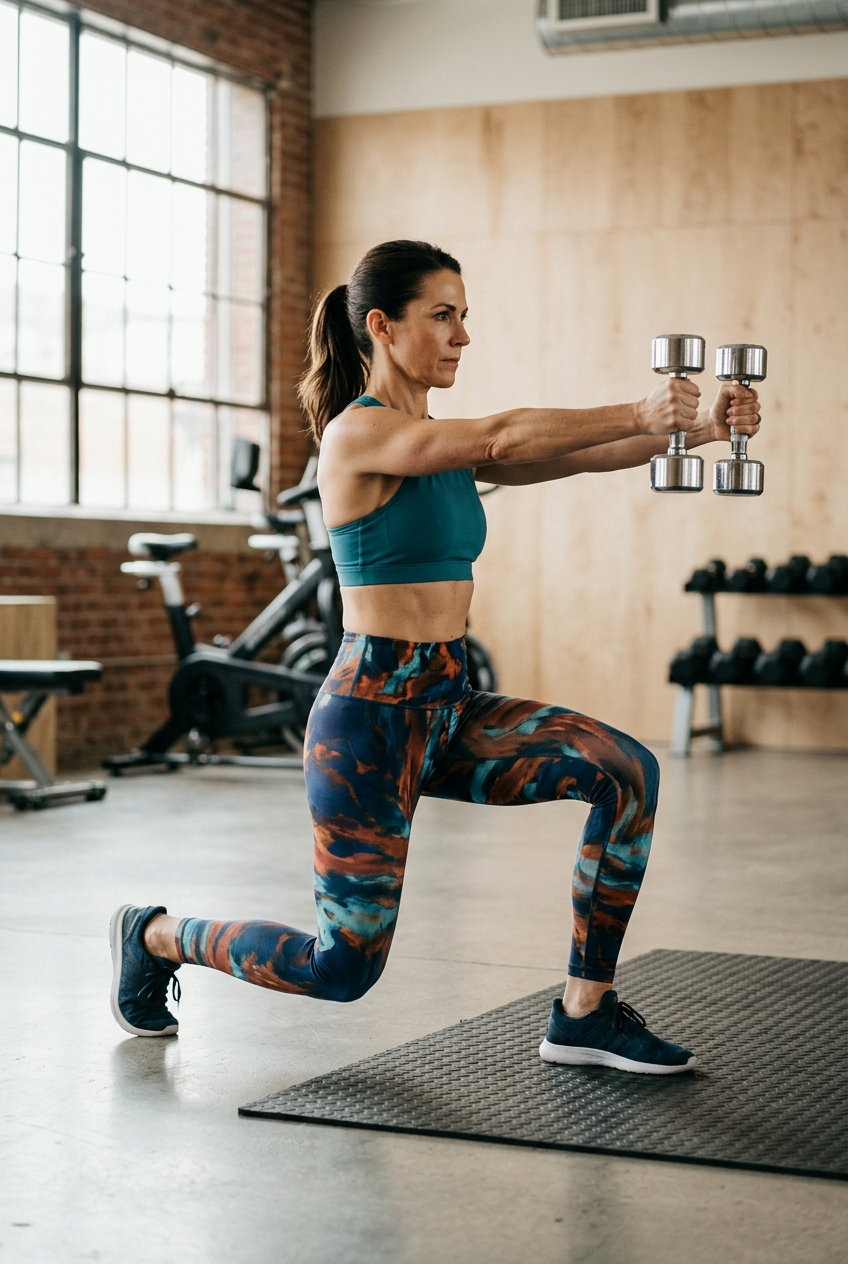
Stand tall with your feet hip-width apart and your core gently braced. Start with just your bodyweight, hands on your hips or out in front for balance. You can add a dumbbell in each hand once the movement feels secure.
The Step Back
Take a controlled step backwards with one foot, landing on the ball of that back foot. Lower your body straight down until both knees are bent at roughly 90 degrees. Your front shin should stay fairly vertical, your front heel planted firmly, and your torso upright and proud.
The Return
Push firmly through the heel of your front foot to drive yourself back up to standing, bringing your back foot to meet the front. Take a breath, reset, and repeat on the other side. Alternate legs, aiming for 8 to 10 repetitions on each side for 3 sets.
Common Mistakes to Avoid
- Leaning forwards. Keep your chest lifted and your torso tall throughout. Leaning forwards shifts strain to your lower back and reduces the work in your glutes.
- Letting the front knee cave inwards. Keep your front knee tracking in line with your middle toes, not collapsing towards the centre.
- Taking too small a step. A step that is too short crowds your front knee. Give yourself enough distance so both knees can bend to 90 degrees comfortably.
- Rushing. Slow and controlled is where the balance benefits live. There is no prize for speed here.
How to Make It Easier or Harder
If balance is a real challenge at first — and for many women it is — do your reverse lunges next to a kitchen counter or sturdy chair, resting a hand on it for support. There is absolutely no shame in this. As you grow stronger, you will find yourself needing it less and less until one day you let go entirely. That moment feels wonderful.
To make the exercise more challenging, add a dumbbell in each hand, then gradually increase the weight. You can also try a deficit lunge by standing on a low step, or slow the lowering phase right down to a count of three to build even more control and strength.
Fitting It Into Your Week
Include reverse lunges once or twice a week as part of a balanced strength routine. Pair them with a hinge like the deadlift, a squat, an upper-body push and pull, and some core work, and you have covered everything your body needs. Two or three short sessions a week is plenty to see real change.
If you are completely new to single-leg work, start with just one set of a few repetitions per side and build gradually. Your balance will improve remarkably quickly — often within just a couple of weeks — and that early progress is wonderfully motivating.
Strength That Keeps You Free
I always come back to this: the goal of training after 40 is not to look a certain way, though feeling strong in your own body is a beautiful thing. The real goal is freedom — the freedom to move through your life without fear of falling, to keep doing the things you love, to stay independent and capable for decades to come.
The reverse lunge is one of the most direct paths to that freedom. Every wobbly repetition you steady, every step you make more controlled, is an investment in the strong, confident, independent woman you are becoming. Start where you are, hold on if you need to, and trust the process. Your future self will thank you for it. 💛
Free 7-Day Beginner Strength Plan
Three simple full-body dumbbell workouts with form cues, warm-ups and rest days built in — designed for women over 40.
🔒 No spam, ever. Unsubscribe anytime.
Want personalised help with this?
My 1:1 online coaching gives you a fully custom training and nutrition plan built around your goals, your body, and your life. 12 weeks, $69/week, with me in your corner the whole way.
Learn About CoachingFree 7-Day Fat Loss Meal Plan
A printable week of protein-forward meals, shopping list, meal prep guide and tracker — designed for women over 40.