Shoulder Exercises for Women Over 40: Ease Pain, Stand Taller, Reach With Confidence
Reach into the back seat of the car. Lift a suitcase into the overhead locker. Fasten a bra, wash your hair, put a plate on the top shelf. Every one of those everyday movements depends on your shoulders — and for a lot of women over 40, that is exactly where things start to twinge, click, ache or simply refuse to cooperate. The good news is that stiff, painful, weak shoulders are not an inevitable part of getting older. They respond beautifully to the right kind of training, at any age.
Your shoulder is the most mobile joint in your whole body, which is precisely why it needs strength and control to stay healthy. In this guide I will walk you through why shoulders struggle after 40, and six simple, joint-friendly exercises to build strong, mobile, pain-resistant shoulders using nothing more than a pair of light dumbbells and a resistance band.
Free 7-Day Beginner Strength Plan
Three simple full-body dumbbell workouts with form cues, warm-ups and rest days built in — designed for women over 40.
🔒 No spam, ever. Unsubscribe anytime.
Why Shoulders Struggle After 40
If your shoulders feel less reliable than they used to, you are not imagining it. Several things stack up in midlife:
- Years of desk and phone posture — hours spent rounded forward shorten the chest and weaken the upper back, pulling the shoulders out of their strongest position.
- Declining muscle mass — the small stabilising muscles of the rotator cuff quietly waste away without regular use, leaving the joint less protected.
- Hormonal changes — falling oestrogen affects tendons and the joint capsule, which is part of why frozen shoulder is so much more common in women between 40 and 60.
- Doing nothing, or doing too much too soon — shoulders dislike both neglect and sudden heavy overhead work with no preparation.
The fix is not to avoid using your shoulders. It is to train them deliberately, with control, in a range they can handle — and then gradually ask for a little more.
What Changes When You Train Your Shoulders
Everyday Tasks Get Easier
Lifting, reaching, carrying and overhead work all stop feeling like a gamble. Strong shoulders turn "I hope this doesn't hurt" into "I've got this."
Less Neck and Upper Back Tension
When the shoulder and upper back muscles are strong, they hold your head and arms without overloading your neck. Many women find their nagging neck tightness eases once they start training this area.
Better Posture and a More Confident Line
Strengthening the rear shoulders and upper back pulls you out of the forward hunch, so you stand taller — and toned, capped shoulders look wonderful in a vest top too.
Real Injury Protection
A strong, well-controlled rotator cuff keeps the ball of the joint centred where it belongs, dramatically lowering your risk of impingement, strains and that dreaded frozen shoulder.
6 Shoulder Exercises for Women Over 40
Move through these with control — no swinging, no rushing. If any exercise causes sharp or pinching pain (as opposed to normal muscular effort), stop and scale it back.
1. Band Pull-Apart
Hold a light resistance band in front of you at chest height, arms straight. Squeeze your shoulder blades together and pull the band apart until your arms are out wide, then return slowly. This wakes up the rear shoulders and upper back — the exact muscles that fix posture. Start every session with these. 2–3 sets of 12–15.
2. Dumbbell Lateral Raise
Stand tall with a light dumbbell in each hand by your sides. With a soft bend in the elbows, raise your arms out to the sides until they reach shoulder height, then lower slowly. Keep the movement smooth and the weight light — this shapes and strengthens the cap of the shoulder. 3 sets of 10–12.
3. Standing Overhead Press
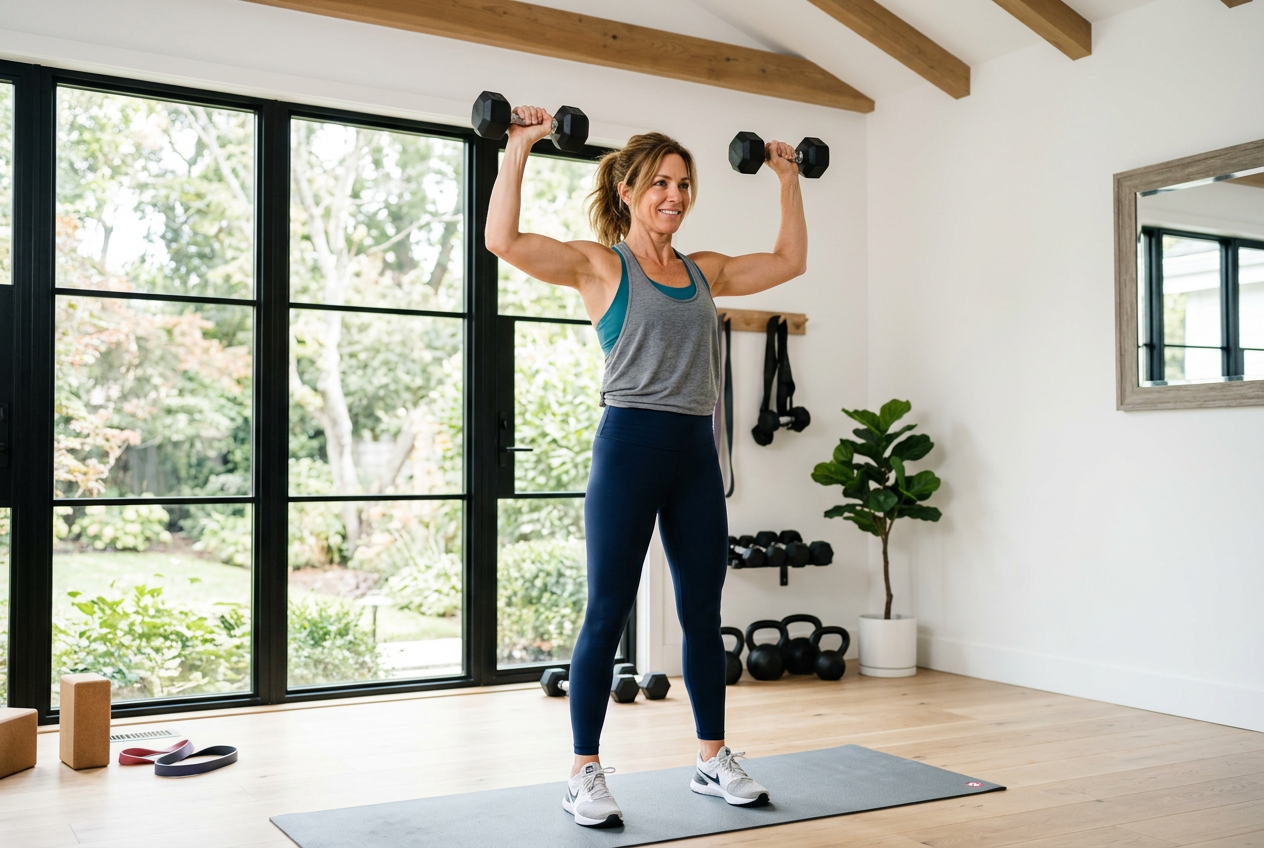
Hold dumbbells at shoulder height, palms facing forward. Brace your middle, then press the weights overhead without arching your lower back. Lower under control. This is the big one for functional overhead strength — reaching the top shelf, lifting a bag overhead. Start light. 3 sets of 8–10.
4. Front Raise
With a dumbbell in each hand resting on the fronts of your thighs, lift one or both arms straight out in front to shoulder height, then lower slowly. This strengthens the front of the shoulder used in every pushing and reaching motion. 2–3 sets of 10.
5. External Rotation (Rotator Cuff)
Tuck your elbow into your side, bent at 90 degrees, holding a light band or very light dumbbell. Keeping the elbow glued to your ribs, rotate your forearm outwards, then return slowly. This tiny movement trains the rotator cuff — the single best insurance policy against shoulder injury. Do not rush it. 2–3 sets of 12 each arm.
6. Bent-Over Reverse Fly
Hinge forward at the hips with a light dumbbell in each hand hanging beneath you. Squeeze your shoulder blades together and raise your arms out to the sides like wings, then lower slowly. This hits the rear shoulders and upper back — the postural heroes most of us neglect. 3 sets of 10–12.
A Simple Weekly Shoulder Plan
You do not need to train shoulders every day. Two short sessions a week, ideally spaced a few days apart, is plenty:
Session A (Push Focus)
- Band Pull-Apart — 2 sets of 15 (warm-up)
- Standing Overhead Press — 3 sets of 8–10
- Lateral Raise — 3 sets of 10–12
- Front Raise — 2 sets of 10
Session B (Posture and Cuff Focus)
- Band Pull-Apart — 2 sets of 15 (warm-up)
- Bent-Over Reverse Fly — 3 sets of 10–12
- External Rotation — 3 sets of 12 each arm
- Lateral Raise — 2 sets of 12
Daily Bonus
A single set of band pull-aparts most days works wonders for posture — do them while the kettle boils.
Common Mistakes to Avoid
- Going too heavy. Shoulders are small joints. Light weights done well beat heavy weights done badly, every time.
- Shrugging up to your ears. Keep your shoulders relaxed and down away from your ears throughout — let the shoulder muscles work, not your neck.
- Arching your back on the overhead press. Brace your middle so the effort stays in your shoulders, not your lower back.
- Skipping the rotator cuff work. It feels minor, but it is the most protective thing on this list. Do not leave it out.
- Rushing. Slow, controlled reps build strength and protect the joint. Momentum helps no one.
A Note on Shoulder Pain
Normal muscular fatigue is fine and expected. Sharp, pinching or radiating pain is not. If you have an existing shoulder injury, frozen shoulder or pain that lingers, please check in with your GP or a physiotherapist before starting — and when in doubt, reduce the range and the weight rather than pushing through.
Strong Shoulders, Stronger Everyday Life
Your shoulders carry you through almost every task you do above waist height. Give them twenty focused minutes twice a week and they will repay you with less pain, better posture and the quiet confidence of reaching, lifting and carrying without a second thought. Pick up a pair of light dumbbells and a band, start with the pull-aparts, and build from there. Your future self — reaching effortlessly into that overhead locker — will thank you.
Free 7-Day Beginner Strength Plan
Three simple full-body dumbbell workouts with form cues, warm-ups and rest days built in — designed for women over 40.
🔒 No spam, ever. Unsubscribe anytime.
Want personalised help with this?
My 1:1 online coaching gives you a fully custom training and nutrition plan built around your goals, your body, and your life. 12 weeks, $69/week, with me in your corner the whole way.
Learn About CoachingFree 7-Day Fat Loss Meal Plan
A printable week of protein-forward meals, shopping list, meal prep guide and tracker — designed for women over 40.