Standing Exercises for Women Over 40: A Full-Body Workout Without Getting on the Floor
Not everyone wants to get down on the floor to exercise — and you absolutely do not have to. Whether it is creaky knees that make getting up and down uncomfortable, a dodgy back that hates lying flat, or you simply prefer to stay upright, standing exercises can give you a brilliant full-body workout without ever touching the ground.
These exercises are perfect for women over 40 who want to build strength, improve balance and stay active — all from a standing position. You can do them in your living room, your office or even your kitchen while the kettle boils. No mat, no floor, no fuss.
Free 7-Day Beginner Strength Plan
Three simple full-body dumbbell workouts with form cues, warm-ups and rest days built in — designed for women over 40.
🔒 No spam, ever. Unsubscribe anytime.
Why Standing Exercises Are Brilliant After 40
Standing exercises have some unique advantages that floor-based exercises simply cannot match:
- They challenge your balance. Every standing exercise forces your stabiliser muscles to work, which improves balance and reduces your risk of falls — something that becomes increasingly important after 40.
- They are joint-friendly. No kneeling, no lying on hard surfaces, no pressing your wrists into the floor. If you have arthritis, knee problems or wrist issues, standing exercises remove those barriers entirely.
- They mimic real life. You do not live your life lying on the ground. Standing exercises train your body in the positions you actually use — reaching overhead, bending to pick things up, carrying bags, climbing stairs.
- They burn more calories. Because you are supporting your full body weight and engaging more muscles for balance, standing exercises generally burn more energy than their floor-based equivalents.
8 Standing Exercises for a Full-Body Workout
1. Standing March (Warm-Up)
Stand tall and march on the spot, lifting your knees to hip height. Swing your arms naturally. Continue for 60 seconds to warm up your muscles and get your heart rate up gently.
Works: Hip flexors, core, cardiovascular warm-up. This gets blood flowing to every major muscle group before you load them.
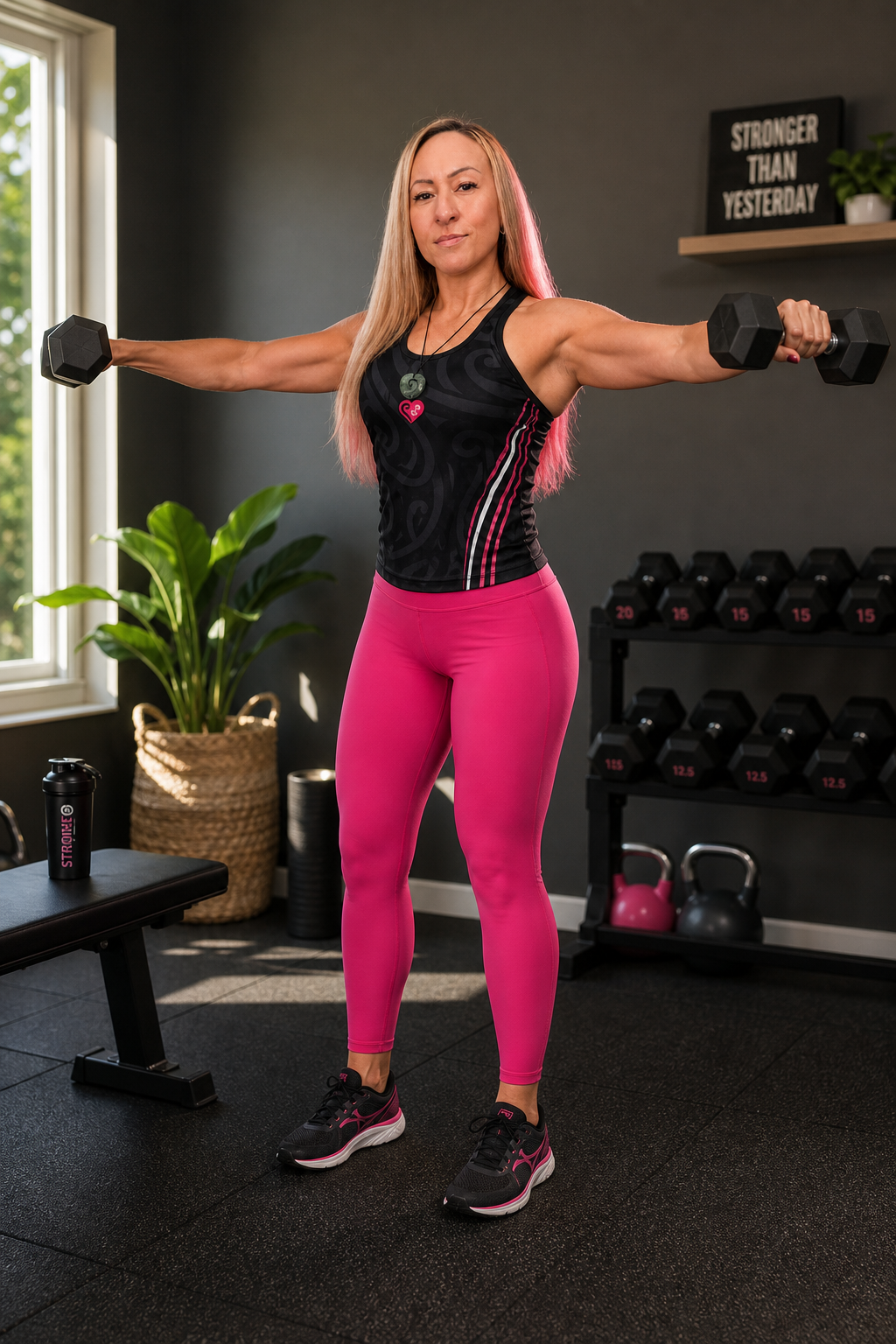
2. Dumbbell Lateral Raise
Stand with feet hip-width apart, holding a light dumbbell in each hand by your sides. Keeping a slight bend in your elbows, lift both arms out to the sides until they reach shoulder height. Pause, then lower slowly. Do 12 reps for 3 sets.
Works: Shoulders (deltoids) and upper back. This is the exercise that builds those beautiful, defined shoulders and improves your posture. Start with 1–2kg dumbbells — shoulders fatigue quickly.
3. Standing Bicep Curl to Overhead Press
Hold a dumbbell in each hand at your sides. Curl the weights up to your shoulders (bicep curl), then press them overhead until your arms are straight (shoulder press). Reverse the movement back down. Do 10 reps for 3 sets.
Works: Biceps, shoulders and triceps. This compound movement gives you two exercises in one, making it incredibly time-efficient. It also challenges your core to stay stable throughout.
4. Standing Knee-to-Elbow Crunch
Stand with your hands behind your head, elbows wide. Lift your right knee up and across towards your left elbow, crunching your obliques. Return to standing and repeat on the other side. Do 10 reps each side for 3 sets.
Works: Obliques, hip flexors and balance. This is a standing ab exercise that targets the waistline without a single sit-up. The balance challenge makes it even more effective than a floor crunch for functional core strength.
5. Squat (Bodyweight or Dumbbell)
Stand with feet slightly wider than hip-width. Push your hips back and bend your knees to lower into a squat — as if you are sitting into a chair. Keep your chest tall and your weight in your heels. Stand back up by pressing through your heels. Do 12–15 reps for 3 sets.
Works: Quads, glutes, hamstrings and core. The squat is the king of lower body exercises and you never need to get on the floor for it. Hold dumbbells at your shoulders to increase the challenge as you get stronger.
6. Standing Calf Raise
Stand behind a chair for balance. Rise up onto the balls of your feet, lifting your heels as high as possible. Hold for 2 seconds at the top, then lower slowly. Do 15 reps for 3 sets.
Works: Calves and ankle stability. Strong calves help with balance, reduce the impact on your knees when walking, and keep your ankles stable — all essential for staying active and injury-free.
7. Standing Reverse Lunge
Stand tall, then step your right foot back into a lunge, lowering your right knee towards the floor (but not touching it). Push through your front heel to return to standing. Do 10 reps on each side for 3 sets.
Works: Glutes, quads, hamstrings and balance. The reverse lunge is gentler on the knees than a forward lunge because the momentum goes backwards, not forward over the knee joint. Hold dumbbells to progress.
8. Standing Woodchop
Hold a dumbbell or water bottle with both hands. Start with the weight at your right hip. In one smooth movement, sweep the weight diagonally up and across your body to above your left shoulder, rotating your torso as you go. Control it back down. Do 10 reps each side for 3 sets.
Works: Core (especially obliques), shoulders and hips. The woodchop trains your core in a rotational pattern — something most exercises miss. It is fantastic for building a strong, functional midsection that supports everything else you do.
Putting It Together: A 20-Minute Standing Workout
Here is a simple way to use these exercises as a complete session:
- Warm-up: Standing March — 60 seconds
- Circuit (repeat 3 times):
- Squat — 12 reps
- Lateral Raise — 12 reps
- Standing Knee-to-Elbow — 10 each side
- Reverse Lunge — 10 each side
- Bicep Curl to Press — 10 reps
- Rest 60 seconds between circuits
- Finisher: Calf Raises — 15 reps, Woodchops — 10 each side
Do this 2–3 times a week and you have a complete strength program that never asks you to get on the floor.
Tips for Getting the Most Out of Standing Exercises
- Wear supportive shoes (or go barefoot on a non-slip surface). Standing exercises rely on a stable base.
- Keep a chair nearby for balance support on single-leg movements. There is no shame in holding on — it is smart training.
- Start with bodyweight only and add light dumbbells (1–3kg) once the movement feels comfortable and controlled.
- Breathe. Exhale on the effort (the lift, the press, the crunch) and inhale on the return. Never hold your breath.
- Go slow. Fast reps use momentum instead of muscle. Slow, controlled movement is where the real strength gains happen.
The Bottom Line
You do not need to get on the floor to get a great workout. Standing exercises are functional, joint-friendly, and challenge your balance in ways that floor exercises simply cannot. They train your body for real life — and they are accessible to almost everyone, regardless of fitness level or mobility limitations.
Save this list, try the 20-minute circuit this week, and see how strong you can feel without ever touching the ground. 💛
Free 7-Day Beginner Strength Plan
Three simple full-body dumbbell workouts with form cues, warm-ups and rest days built in — designed for women over 40.
🔒 No spam, ever. Unsubscribe anytime.
Want personalised help with this?
My 1:1 online coaching gives you a fully custom training and nutrition plan built around your goals, your body, and your life. 12 weeks, $69/week, with me in your corner the whole way.
Learn About CoachingFree 7-Day Fat Loss Meal Plan
A printable week of protein-forward meals, shopping list, meal prep guide and tracker — designed for women over 40.