Strength Training Myths Women Over 40 Still Believe (Let's Clear Them Up)
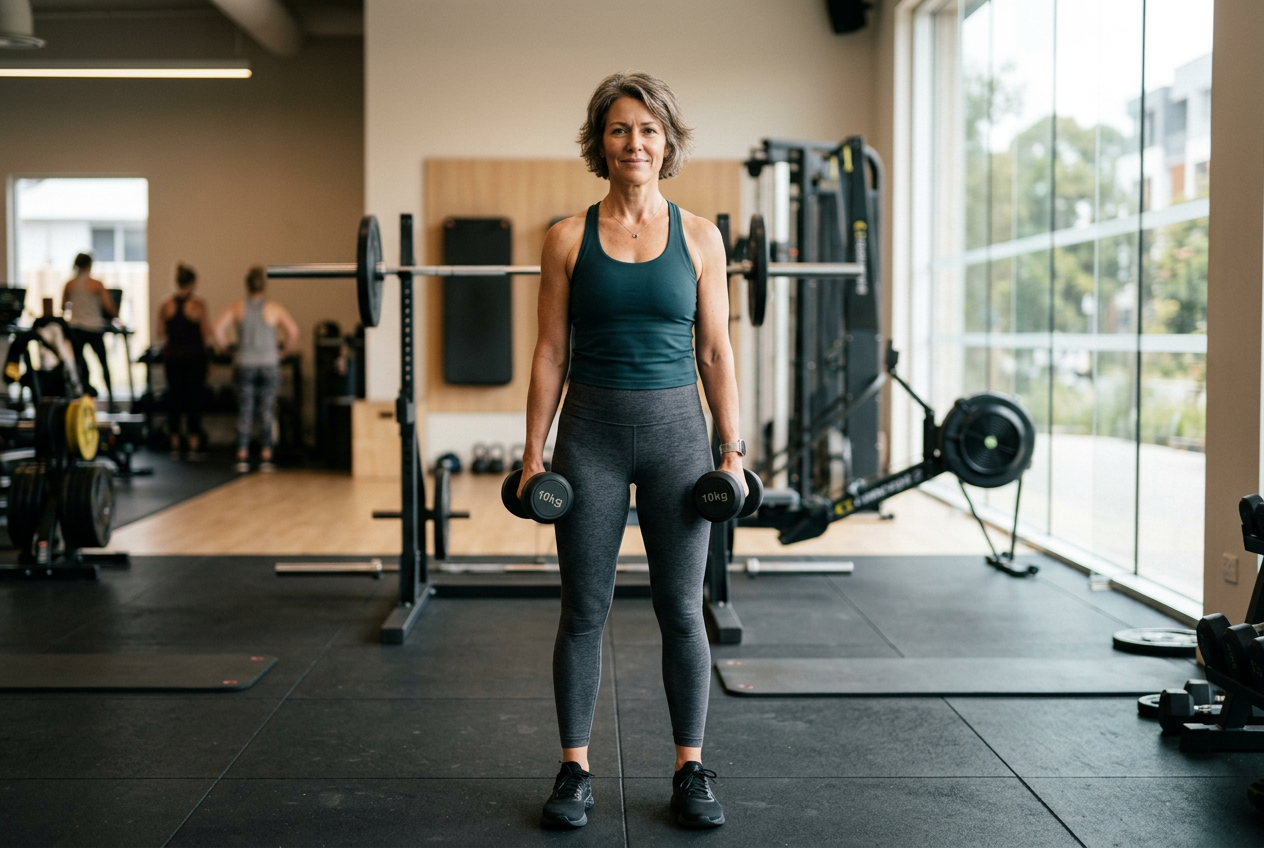
I hear them all the time. In DMs, in conversations with new clients, even from women who have been training on and off for years. Myths about strength training that sound reasonable on the surface but quietly hold women back from the results they deserve.
If you are a woman over 40 and you have ever hesitated to pick up a heavier dumbbell, skipped the weights section entirely, or told yourself lifting is not really "for you" — chances are one of these myths is behind it.
Let's clear them up, one by one.
Free 7-Day Beginner Strength Plan
Three simple full-body dumbbell workouts with form cues, warm-ups and rest days built in — designed for women over 40.
🔒 No spam, ever. Unsubscribe anytime.
Myth 1: Lifting weights will make you bulky
This is the big one. The myth that refuses to die. And I completely understand why it feels true — nobody wants to train hard and end up looking like a bodybuilder when that is not their goal.
But here is the reality: women do not have the testosterone levels required to build large, bulky muscles. Not even close. The women you see in bodybuilding competitions train for years with extremely specific programming, strict diets, and in many cases supplementation to achieve that look. It does not happen by accident.
What strength training will do for you after 40 is build lean, defined muscle that sits beautifully on your frame. It gives you shape, tone and that "fit" look that no amount of cardio alone can create. You will look firmer, feel stronger and your clothes will fit better — without getting bigger.
I have worked with hundreds of women over 40 and not a single one has ever come back to me and said "I got too bulky." What they do say is "I wish I had started sooner."
Myth 2: Cardio is better for fat loss than weights
This one has been around for decades and it is stubbornly persistent. The idea that if you want to lose fat, you should be spending your time on the treadmill, the cross-trainer or in a spin class rather than lifting weights.
Here is what the research actually shows: while cardio burns calories during the session, strength training builds muscle — and muscle is metabolically active tissue. That means it burns calories around the clock, even while you are sitting on the sofa watching telly. The more lean muscle you carry, the higher your resting metabolic rate.
After 40, we naturally lose muscle at a rate of roughly 3 to 8 per cent per decade if we do not actively work to maintain it. This is called sarcopenia, and it is one of the biggest reasons metabolism slows down with age. Strength training is the single most effective way to fight it.
Does that mean you should never do cardio? Absolutely not. Walking, swimming and cycling are wonderful for your heart, your mood and your overall health. But if fat loss is a goal, strength training needs to be the foundation — not the afterthought.
Myth 3: You need to lift heavy or it does not count
On the other end of the spectrum, some women feel intimidated because they think they need to be deadlifting 80 kilograms to see results. That if they are not grinding out heavy sets, they are wasting their time.
This is simply not true. Research consistently shows that muscle can be built effectively across a wide range of loads — from heavy weights with low reps to lighter weights with higher reps — as long as you are working close to fatigue. What matters is that the last two or three reps of a set feel genuinely challenging.
If you are a beginner, starting with bodyweight exercises or light dumbbells is not only fine — it is smart. You build proper form, develop joint stability and create a foundation that will serve you for years. Progress comes from gradually increasing the challenge over time, not from lifting the heaviest thing in the room on day one.
Myth 4: Strength training is dangerous for your joints after 40
I hear this one a lot from women who have been told by well-meaning friends or even some health professionals to "take it easy" on their joints. And I understand the concern — nobody wants to make an existing ache worse.
But here is what the evidence says: properly programmed strength training actually protects your joints. Strong muscles act as shock absorbers for your knees, hips and shoulders. They stabilise the joint, reduce the load on cartilage and can significantly reduce pain from conditions like osteoarthritis.
A 2019 review in the British Journal of Sports Medicine found that exercise therapy — including resistance training — was as effective as painkillers for knee osteoarthritis, with none of the side effects. That is remarkable.
The key word here is "properly programmed." You do need to use good form, choose appropriate loads and progress gradually. That is exactly what a good training plan (or coach) gives you. But avoiding weights altogether because you are worried about your joints? That is one of the worst things you can do — because weak muscles mean less joint support, not more.
Myth 5: You are too old to start
This one breaks my heart a little, because I hear it from women in their mid-40s. Their mid-40s! As if there is some invisible deadline after which your body stops responding to exercise.
The truth is your body adapts to strength training at any age. Studies have shown measurable gains in muscle mass, bone density and functional strength in people well into their 70s, 80s and even 90s. Your muscles do not have a use-by date.
Yes, recovery might take a little longer than it did at 25. Yes, you might need to be more thoughtful about warming up and managing load. But the capacity to build strength, improve your body composition and feel incredible in your own skin? That does not expire.
Some of my most inspiring clients started strength training in their late 40s and 50s with zero experience. Within 12 weeks they were stronger, leaner, sleeping better and standing taller — literally and figuratively. It is never too late. Genuinely.
Myth 6: You need a gym to strength train properly
Gyms are wonderful if you enjoy them. But if the thought of walking into a weights room makes you anxious, or you simply prefer training at home — that is completely fine. You do not need a gym to build serious strength.
A set of adjustable dumbbells, a resistance band and a sturdy chair give you everything you need for a full-body programme. Many of my online coaching clients train entirely from their living room or garage and get incredible results.
The best workout is the one you will actually do, consistently, week after week. If that means training at home in your pyjamas at 6am before anyone else is awake — perfect. The weights do not care where you lift them.
What to do instead of believing the myths
If any of these myths have been quietly holding you back, here is my advice:
- Start where you are. Bodyweight, light dumbbells, resistance bands — all of it counts.
- Aim for two to three strength sessions a week. That is enough to see real changes.
- Focus on compound movements — squats, deadlifts, rows, presses. They work multiple muscle groups at once and give you the most bang for your time.
- Progress gradually. Add a little more weight, an extra rep, or a harder variation over time.
- Be patient. Strength builds steadily. You will feel the difference before you see it — and then one day you will catch yourself carrying all the shopping bags in one trip without even thinking about it.
Strength training after 40 is not about punishing your body or chasing a number on the scale. It is about building a body that supports the life you want to live — one that moves well, feels strong and carries you through the next 40 years with confidence.
You are not too old. You are not too weak. And you definitely will not get bulky.
You have got this. 💛
Free 7-Day Beginner Strength Plan
Three simple full-body dumbbell workouts with form cues, warm-ups and rest days built in — designed for women over 40.
🔒 No spam, ever. Unsubscribe anytime.
Want personalised help with this?
My 1:1 online coaching gives you a fully custom training and nutrition plan built around your goals, your body, and your life. 12 weeks, $69/week, with me in your corner the whole way.
Learn About CoachingFree 7-Day Fat Loss Meal Plan
A printable week of protein-forward meals, shopping list, meal prep guide and tracker — designed for women over 40.